As per industry experts, 30% to 45% annual contact center attrition remains common across many operations.
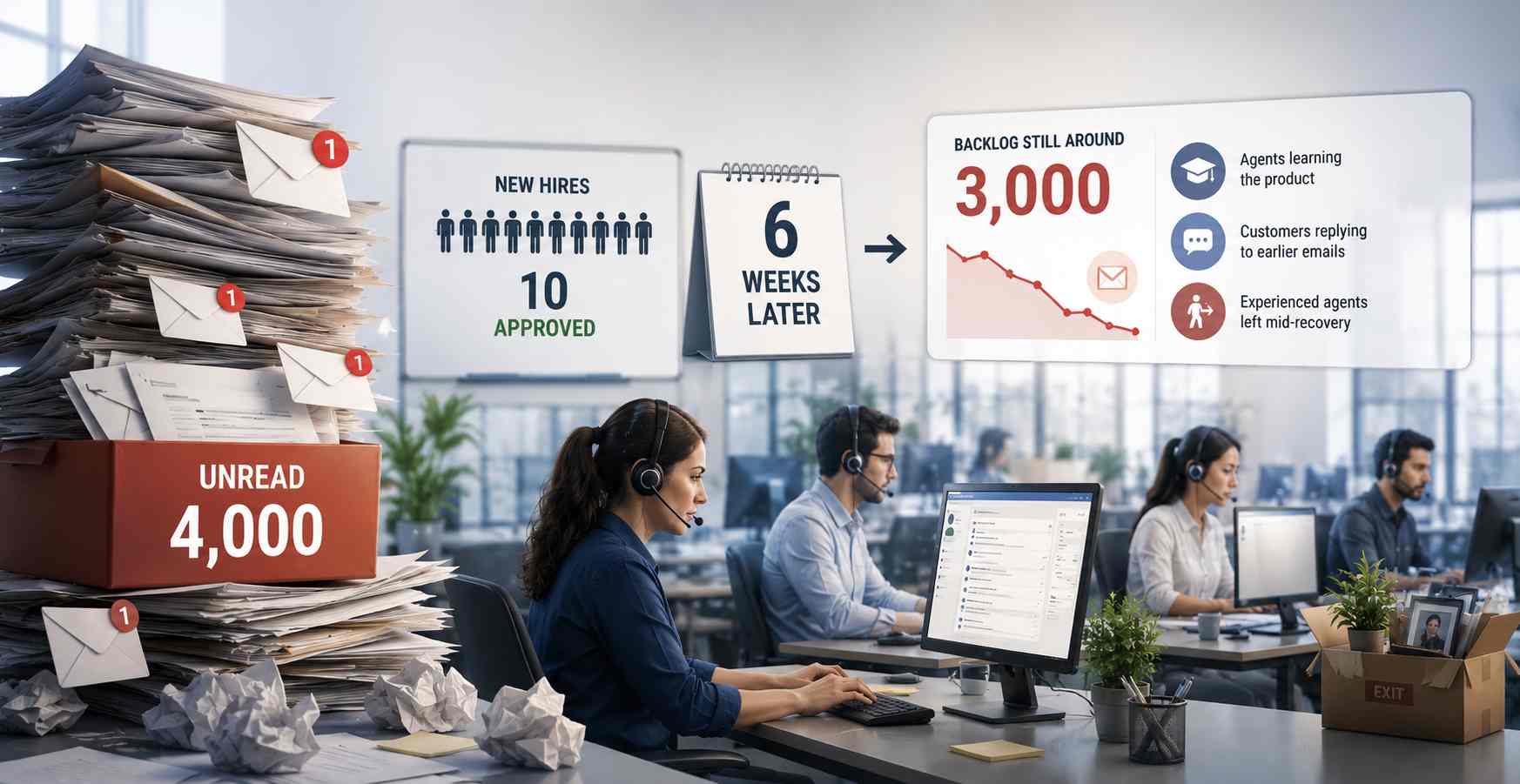
Now put that turnover against a live queue. Picture a support inbox with 4,000 unread emails after a product recall. Leadership approves ten new hires. Six weeks later, the queue is still around 3,000. The new agents spent part of that time learning the product, customers kept replying to earlier messages and two experienced agents left halfway through the recovery.
The headcount went up. The backlog barely did.
That is the trap. A large email queue looks like a staffing problem because the visible symptom is too much work and too few hands. But the cause may sit elsewhere: routing is poor, coverage stops at one time zone or the knowledge base is so outdated that agents do not trust it. Hiring into that setup adds capacity without removing the friction.
Email support outsourcing can help, but the useful model is not simply renting more agents. For a backlog, it works best as a defined recovery exercise: understand the queue, separate the work, clear the aged cases and fix the reasons they accumulate. The aim is not an empty inbox for one week. It is an operation that can keep the inbox under control after the recovery team steps back.
Why Enterprise Email Backlogs Happen (And Keep Happening)
Most backlogs are a pile-up of several small problems rather than one dramatic failure. The table below shows why simply adding headcount often misses the cause.
| Backlog Cause | How It Shows Up | Why Hiring Alone Doesn't Fix It |
|---|---|---|
| Seasonal volume spikes | Weekly email volume suddenly runs well above the staffing plan. | The queue forms before new hires are trained and ready. |
| Product launches, recalls and incidents | A large burst of higher-complexity cases arrives together. | More agents do not remove the need for triage, escalation rules or product knowledge. |
| Attrition and knowledge loss | Experienced people leave while replacements are still learning. | Headcount can rise while effective capacity stays flat. |
| Recontacts, CSAT erosion and churn | Customers follow up, open another thread or switch channels. | The team starts processing demand created by the delay itself. |
Seasonal Volume Spikes That Outpace In-House Capacity
Holiday shopping, renewal periods and back-to-school peaks are predictable, yet teams are often staffed for average demand. A week that runs 40% above normal can create an aging queue within days when there is no spare capacity.
Product Launches, Recalls and Incident-Driven Contact Surges
These spikes are harder because the emails are rarely simple. A recall, billing error or outage can produce thousands of messages at once, and each case may need more care than a routine status request. These situations also require structured complaint management so that serious customer issues are escalated rather than treated as routine backlog.
Attrition and Knowledge Loss on In-House Email Teams
The 30% to 45% annual attrition range matters because replacement headcount is not the same thing as replacement capability. Product knowledge, judgment and familiarity with past cases take time to rebuild.
The Silent Cost of a Backlog: Recontact Rates, CSAT Erosion and Churn
A delayed reply can create another ticket before the first one is even touched. Customers send a follow-up, try omnichannel support such as chat, email or call. The queue then grows partly because the queue exists.
Worked example: if a team receives 10,000 tickets a week and 15% sit in backlog, 1,500 tickets are aging. If 12% of those customers follow up, that creates another 180 contacts. Over four weeks, that is 720 extra contacts before counting any fresh demand. The exact rate will vary by product and customer mix, but the arithmetic shows why backlog recovery has to track recontact, not just closure.
For context, Freshworks' 2023 benchmark used more than 5.3 billion tickets across 25 industries and found a median first response time of 6 hours 47 minutes across its ticketing dataset.
What "Clearing a Backlog" Actually Looks Like Operationally
A backlog is not cleared by taking the oldest message and working forward. The queue has to be sorted before it is attacked, otherwise the fastest cases get attention while the difficult cases continue to age.
Triage: Sorting the Queue by Urgency, Complexity and Age
Start by separating urgent work from routine work, then look at complexity and age. A billing dispute, a password reset and a cancellation threat should not compete for the same treatment simply because they arrived on the same day.
Templated vs Judgment-Based Response Segmentation
Some emails are genuinely repetitive. Others only look repetitive until you read the account history. Separating the two protects response speed without forcing a generic answer onto a case that needs judgment.
| Templated: Close in One Reply | Judgment-Based: Requires Human Thinking |
|---|---|
| Password reset instructions | Billing dispute or duplicate charge |
| Order or application status | Cancellation threat or retention risk |
| Known policy explanation | Exception to a standard policy |
| Routine account verification | Multi-account or multi-product issue |
| Known delivery or appointment update | Sensitive, legal or regulated complaint |
Escalation Path Design for Complex Tickets
A complex case needs a named route to someone with authority to resolve it. If escalation means dropping a ticket into another queue and hoping somebody picks it up, the hardest cases become the oldest ones.
Continuous QA to Prevent Re-Contact Loops
A ticket marked solved is not necessarily a solved problem. During a recovery, sample replies while the work is happening. That catches weak answers early, before a closed ticket returns as another contact.
How Email Support Outsourcing Delivers Backlog Recovery in 30, 60 and 90 Days
A useful recovery has three distinct phases. Each phase has a different job, so the operation should not look the same on day 15 and day 85.
| Phase | Timeline | Primary Objective | Key Deliverable |
|---|---|---|---|
| Phase 1 | Days 1-30 | Diagnose, segment and stabilise | Queue map, triage rules, staffing plan and first response improvement |
| Phase 2 | Days 31-60 | Burn down aged work and reduce recontacts | Lower backlog age, stable throughput and measurable recontact reduction |
| Phase 3 | Days 61-90 | Move to steady state and remove root causes | Updated workflows, knowledge fixes and controls that prevent rebuild |
Days 1-30: Diagnostic, Prioritisation and Rapid Response Ramp
The first month should feel more like a diagnosis than a production sprint. Map the queue, identify repeat reasons and establish escalation routes while agents ramp into the lower-risk work.
Illustrative planning mix, not an industry benchmark: 45% templatable, 25% judgment-based, 10% requiring escalation authority and 20% potentially deflectable through self-service after the knowledge layer is fixed. These categories can overlap in a real queue, so they should be treated as a planning model rather than four mutually exclusive buckets.
Days 31-60: Backlog Burn-Down and Recontact Rate Reduction
The second month is where the aged queue should visibly fall. Throughput matters, but so does what happens after closure. If customers keep replying on the same issue, the operation is moving tickets rather than resolving demand.
Days 61-90: Steady-State Operations and Root Cause Fixes
By month three, the question changes from 'How many are left?' to 'Why did these cases enter the queue?' That may lead to a rewritten macro, a new self-service article, a routing change or a product fix. Those changes are what stop the next spike from becoming another backlog.
The Metrics That Actually Prove a Backlog Is Being Cleared
A falling ticket count is useful, but it can flatter the operation. A better view combines speed with age, resolution quality and the amount of work that comes back.
First Response Time (FRT) Trend Line
Freshworks' 2023 benchmark reports a median ticket first response time of 6 hours 47 minutes across its dataset. Its industry figures include 6 hours 19 minutes for Software and IT, 6 hours 22 minutes for Retail and Ecommerce, 6 hours 41 minutes for Healthcare and Pharmaceuticals, 6 hours 44 minutes for Financial Services and 6 hours 46 minutes for Travel and Hospitality. Freshworks also notes that the benchmark is based on anonymised usage data from January to December 2022.
Zendesk treats first reply time as a core support metric. A recovery should show a sustained improvement rather than a temporary dip.
| Industry | Average Email FRT | Customer Expectation / Operating Target |
|---|---|---|
| SaaS / Software and IT | 6h 19m | 24h email operating target |
| Ecommerce / Retail | 6h 22m | 24h email operating target |
| Healthcare and Pharmaceuticals | 6h 41m | 24h email operating target |
| Financial Services | 6h 44m | 24h email operating target |
| Travel and Hospitality | 6h 46m | 24h email operating target |
Backlog Age Distribution, Not Just Total Count
Two queues can each contain 500 tickets and have very different levels of risk. One may be almost entirely under 24 hours old. The other may have hundreds sitting for a week. Age tells you whether the old work is actually being removed.
Recontact and Reopen Rate
If a customer writes again about the same issue after the ticket was closed, the first response did not finish the job. Track this beside closures so the recovery does not reward shallow answers.
CSAT on Ticket Closure
Freshworks reports a median ticket CSAT of 89.58% in its 2023 benchmark. Freshworks During a backlog recovery, a sudden drop in CSAT can be an early sign that speed is being bought at the expense of quality.
Cost Per Resolved Ticket
Cost per handled ticket can hide repeat work. For planning, published industry estimates put human-handled email support at roughly $5 to $15 per resolved ticket, depending on geography, complexity and what management, QA and tooling are included. Treat this as a planning range, not a universal rate.
How AI and Automation Speed Up Email Backlog Recovery in 2026
AI is useful when the work is repetitive and the rules are clear. It becomes risky when the answer depends on context, exceptions or a decision the system is not authorised to make.
Auto-Tagging and Intent Classification at Ingestion
A classified ticket might arrive as: 'Refund charged twice on account 48219' → Billing > Duplicate Charge; urgency: High; sentiment: Negative; intent: Refund; route: Finance Tier 2. The point is simple: the agent starts with the case framed instead of spending the first few minutes deciding where it belongs.
Reply Suggestions and Templated Response Assist
For routine cases, AI can draft a reply from approved content. The agent still checks the answer, account context and tone before sending it. That small human step matters when a template meets an exception.
Sentiment-Based Prioritisation
A calm request and an angry third attempt can carry the same intent tag. Sentiment gives the queue another signal so the third attempt does not sit behind a routine request simply because both are labelled 'billing'.
Where Automation Ends and Human Judgment Starts
| AI Can Handle Reliably | Human Must Handle |
|---|---|
| Intent and category classification | Policy exceptions and ambiguous cases |
| Urgency and sentiment scoring | Escalated complaints and retention risk |
| Drafting from approved knowledge | Novel problems with no trusted answer |
| Duplicate detection and case summaries | Billing disputes and discretionary adjustments |
| Routine status updates and routing | Regulated, legal or high-impact decisions |
Liveops cites Salesforce projections that AI could resolve roughly half of service cases by 2027, compared with about 30% in 2025. That projection does not mean judgment-heavy work disappears. It means routine work is increasingly a candidate for automation.
What Enterprises Should Evaluate in an Email Support Outsourcing Partner
Price matters, but a low rate does not clear an old queue by itself. The useful questions are about ramp, integration, quality, coverage and how the partner is paid.
Ramp Speed: Can They Deploy Agents in 2-4 Weeks?
Ask for a dated ramp plan tied to your ticket categories. A generic promise to scale is not the same as showing how training, access and nesting will happen.
Helpdesk Integration Depth (Zendesk, Freshdesk, Salesforce)
Agents should work in the enterprise's existing helpdesk where possible, with customer history and open cases visible. A parallel inbox creates another handoff.
Brand Voice and QA Framework
Ask to see the scoring rubric. Tone, accuracy, resolution quality and brand adherence should be scored consistently, then fed into coaching.
Data Security and Compliance
For regulated queues, ask which controls and certifications apply to the actual data agents will handle. A provider's general compliance claim is not enough.
Multilingual and Time-Zone Coverage
If the existing queue grows overnight because coverage stops, extending the same hours only moves the problem. Coverage should match the demand pattern.
Commercial Model: Per-Ticket, Per-Agent or Outcome-Based
Per-ticket pricing can reward speed even when the answer is weak. Models tied to quality or recontact outcomes can better fit a recovery.
What to Watch for During the First 30 Days of an Outsourced Email Engagement
The first month tells you whether the recovery is actually working. Look at the work itself, not just the dashboard.
Response Quality Sampling
Read real replies every week. A fast answer that misses the customer's actual question is not progress.
Escalation Discipline
Check whether complex cases reach the right person or are being closed with a template just to improve the closure count.
Backlog Age Trend, Not Volume
The total can fall while the oldest work sits untouched. Track the age bands.
Root-Cause Themes Emerging From Ticket Data
By day 30, the partner should be able to name recurring reasons customers are contacting support and show what is being changed.
When Outsourcing Is Not the Right Fix
Outsourcing adds capacity. It does not fix every reason a queue exists. Before moving work to a partner, check whether the source of demand sits upstream.
The Backlog Is Caused by a Product Defect
If a broken feature is generating the emails, more agents only process the symptom faster. Fix the defect and use support capacity to handle the remaining demand.
The Self-Service Portal Is Broken or Untrusted
If customers cannot find an answer or the portal conflicts with agent guidance, repair the knowledge layer first. Otherwise, the business pays people to answer questions it already tried to publish.
The Channel Design Is Creating Avoidable Email
If customers are pushed into email for actions that could happen through authenticated self-service, in-product workflows or proactive updates, the channel design is creating the queue.
Why 1Point1 Is a Fit for Enterprise Email Backlog Recovery
1Point1's published email support model is built around more than adding agents. It includes AI email triage and sentiment detection, direct integration with Zendesk, Salesforce and Freshdesk, SLA dashboards and multilingual support.
The company publishes more than 1,200 certified email support experts, a reported 71% decrease in first response time, approximately 92% successful escalation resolution and up to a 70% drop in average resolution time. These are 1Point1's published service metrics, not independent benchmarks.
For ramp planning, 1Point1's published omnichannel guidance says implementation typically takes four to six weeks depending on channel count and CRM complexity. Its live chat operation publishes a two to four week deployment window. Enterprises should therefore ask for a written email-specific ramp plan rather than assume the faster chat timeline applies to email.
1Point1's omnichannel customer service describes structured onboarding and integration work, while its email service page names Zendesk, Salesforce and Freshdesk as supported integrations.
Its published delivery footprint includes Mumbai, Gurgaon, Indore, Bengaluru and Chennai, alongside global delivery centres. 1Point1’s published contact information provides the current location and contact details.
For QA, 1Point1 describes scorecards that assess areas such as tone, accuracy, resolution quality and brand adherence, supported by operational reporting. This provides an enterprise with a framework for reviewing written-response quality alongside operational measures such as first-response time, resolution time, backlog age and recontact rates.
A published anonymized email management case study involving a large government body reported that, after centralizing inbox management, integrating APIs, and introducing live queue tracking, email turnaround time decreased from 74 minutes to 18 minutes, while pending emails became nearly non-existent. These results are presented in 1Point1’s case-study material as a 1Point1 client outcome and should therefore be treated as a reported case result rather than an independently validated benchmark.
That is the key distinction when addressing a backlog: the partner is not simply adding capacity. It is also contributing to a broader customer experience management model designed to improve service quality and operational performance. The engagement should help diagnose the backlog, operate within the existing helpdesk environment, ramp capacity against defined categories, measure response quality, and establish controls that reduce the likelihood of future backlogs.
Conclusion
An email backlog looks like a volume problem from the outside. Inside the operation, it is often a mix of thin coverage, weak routing, lost knowledge and avoidable repeat contacts.
More people can help, but only if the process they enter is clear. A stronger recovery starts by understanding what is sitting in the queue, separating routine work from cases that need judgment, then measuring whether the work stays resolved.
That is why a 30-60-90 day recovery is more useful than a promise to answer more emails. The real test is whether the aged queue falls, recontacts fall with it and the operation can handle the next spike without rebuilding the same problem.