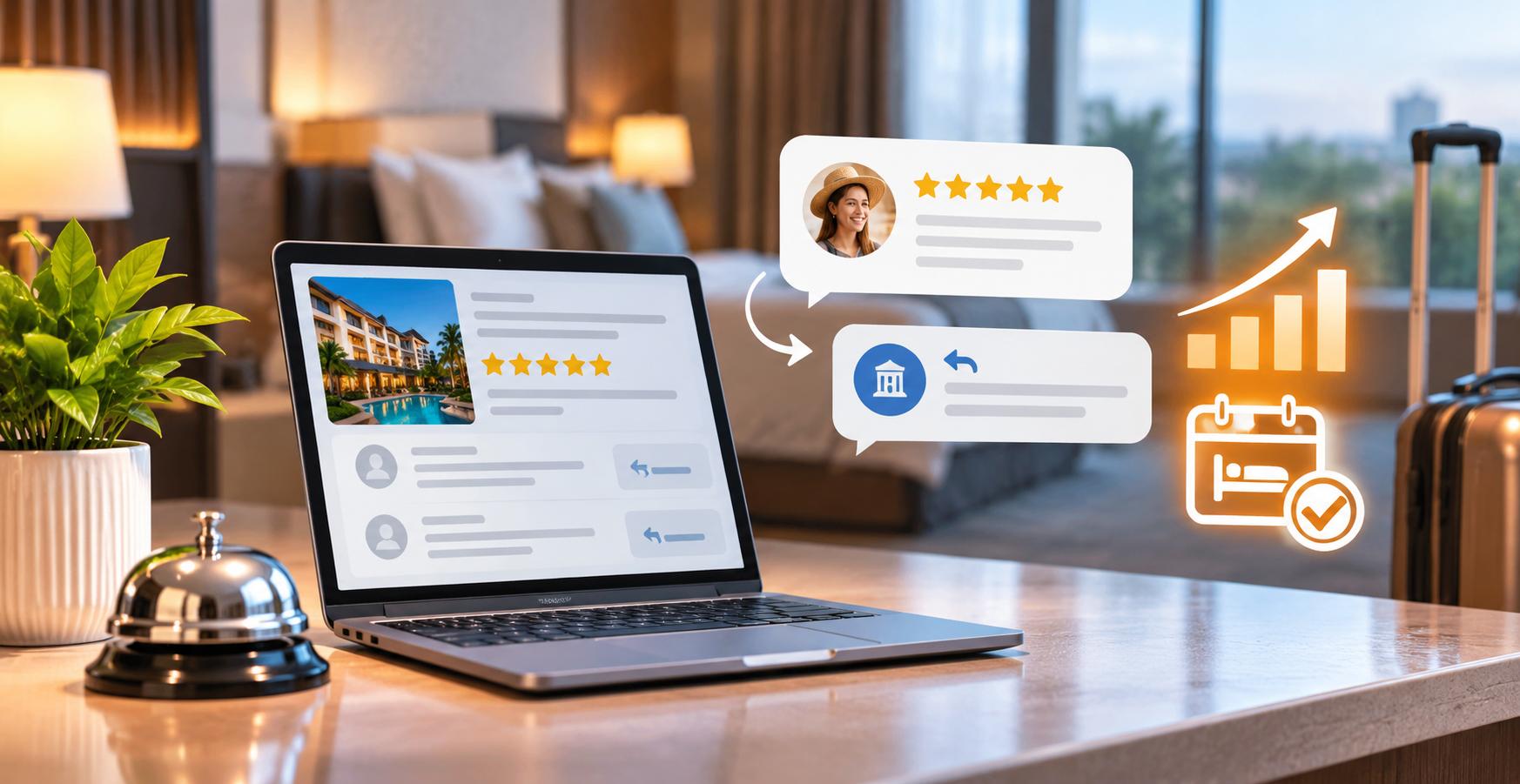
Hotel online reputation management involves monitoring, responding to and acting on guest reviews across OTAs, Google and social channels. An Ipsos MORI survey of more than 23,000 TripAdvisor users found that 77% of travellers are more likely to book when hotel owners leave personalised review responses. This makes every public reply an opportunity to influence future booking decisions, not just address individual guest feedback.
Most hotels treat replies as an afterthought, typed whenever there is spare time. That misses the point. This guide covers negative and positive review response, where reputation actually lives beyond TripAdvisor, turning review data into operational fixes, and why hotel groups increasingly outsource the function.
Why Review Responses Are a Booking Driver, Not a Chore
Review responses change booking behaviour and how a property reads against competitors.
The Numbers, Travellers Book More When Owners Respond
An Ipsos MORI survey of over 23,000 TripAdvisor users found that 63% of travellers would book a hotel if the owner responded to most of its reviews. A TrustYou and NYU study also found that 95% of travellers read reviews before booking.
How a Public Response Influences Every Future Reader, Not Just the Reviewer
A response stays visible to everyone who reads that review afterward. The same Ipsos survey found 79% of travellers said personalised responses make reviews more useful, and 90% said polite replies make them believe the owner genuinely cares.
Why Silence Costs More Than a Difficult Review
A hard review with no response reads as a hotel that does not care. A Harvard Business Review analysis by Davide Proserpio and Giorgos Zervas found hotels that start responding receive 12% more reviews going forward, with average ratings rising 0.12 stars.
Where Your Reputation Actually Lives (Beyond TripAdvisor)
TripAdvisor gets the attention, but it is one listing among many shaping how a traveller sees a property.
OTAs, Metasearch and Google Business Profile
Booking.com, Expedia, Google Business Profile and metasearch sites like Trivago each carry their own review feed. A guest comparing hotels on Google Maps may never open TripAdvisor at all.
Social Channels and Direct Post-Stay Feedback
Instagram comments, Facebook reviews and direct messages carry reputational weight without a star rating attached. Post-stay surveys catch dissatisfaction before a guest posts publicly.
Why an Accurate, Refined Listing Builds Trust Before the First Review
Photos, descriptions and pricing accuracy set expectations before arrival. A mismatch between listing and stay is a common root cause of negative reviews, so keeping listings current reduces avoidable complaints.
How to Respond to Negative Reviews Without Making It Worse
A badly handled response can do more damage than the original review. The goal: de-escalate publicly, resolve privately.
The Acknowledge-Empathise-Act-Invite Structure
This structure works for almost every negative review. Acknowledge the specific issue, not a vague apology. Empathise with how it affected the stay. State the action taken. Invite the guest to return or continue offline.
The 24-Hour Window That Makes Guests Upgrade Their Rating
Speed matters less than many assume. Responding within 24 hours versus 48 hours produced only a 2-3% improvement in reader sentiment, while 48 hours instead of a full week produced 15%. A thoughtful reply within two days beats a rushed one.
What Never to Do, Templated, Defensive or Argumentative Replies
Copy-pasted replies read as copy-pasted, and guests notice when a response ignores the complaint. Arguing with a guest in public turns one bad review into a visible pattern future readers will remember.
How to Respond to Positive Reviews So They Actually Convert
Positive reviews get ignored far too often, yet a good reply to a good review does real marketing work.
Personalisation That Signals Attentiveness to Future Guests
Referencing a specific detail, a staff member, a dish from the restaurant, shows future readers the team actually reads what guests write. A generic thank-you wastes that opportunity.
Reinforcing Your Differentiators in the Reply
If a guest praises the rooftop pool or the breakfast spread, the reply reinforces that feature for every future reader scanning the section.
Turning Happy Guests Into Repeat and Referral Bookings
A warm, specific reply to a loyal guest, mentioning a loyalty programme or inviting them back, nudges a one-time stay toward a repeat booking.
Turning Review Data Into Operational Improvement (The Part Most Hotels Skip)
Review response matters less if the same complaint keeps repeating. Reviews are a free, constant stream of research data.
Spotting Recurring Themes by Room Type, Channel and Stay Length
Categorising reviews by room type, booking channel and stay length helps hotels identify recurring issues that individual ratings may hide. For example, if several guests staying in standard rooms mention noise disturbances, the problem may relate to a specific room category rather than the entire property. Tracking these patterns helps managers prioritise inspections, maintenance and service improvements instead of treating every complaint as an isolated incident.
Feeding Patterns Back to Housekeeping, F&B and Front Desk
Review insights become useful when they reach the teams responsible for resolving complaints. Hotels can share weekly feedback summaries with housekeeping, food and beverage (F&B) and front-desk managers. For example, repeated complaints about delayed room readiness can prompt housekeeping and front-desk teams to review room turnover schedules and check-in coordination. Assigning clear ownership ensures guest feedback leads to operational action rather than remaining in a reporting dashboard.
The Feedback Loop That Prevents the Next Bad Review
A structured feedback loop connects guest complaints with corrective action and follow-up monitoring. For example, if breakfast service delays appear repeatedly in reviews, hotel managers can adjust staffing or service schedules and track whether complaints decline in subsequent weeks. Comparing review themes before and after operational changes helps teams assess whether improvements are working and address recurring issues before they affect more guests.
Personalisation at Scale, Where AI Helps and Where Humans Must Stay
Large groups cannot personalise every reply manually at volume. AI changes what is realistic without replacing judgment.
AI-Drafted, Human-Edited Responses for High Review Volume
AI can draft a first-pass response referencing the specific details in a review within seconds, cutting time spent per reply. A human still reads and edits before anything posts.
Keeping Every Reply On-Brand and Genuinely Specific
A brand voice guide and an approval step keep AI-assisted replies from drifting generic. The draft gives speed, the human edit gives accuracy.
Why Fully-Automated Replies Backfire
Guests can tell when a response is generic, and a generic reply to a genuine complaint reads as dismissive. A fully automated reply with no human check risks sounding tone-deaf exactly when attentiveness matters most.
Why Hotels Outsource Review Response Management
How Much Does Outsourced Hotel Review Response Management Cost?
Outsourced review response pricing depends on monthly review volume, platform coverage, language requirements and the level of human oversight. Hotels can evaluate three common pricing models:
- Per-review Pricing: Charges are linked to the number of guest reviews handled.
- Monthly Retainer: A fixed recurring fee covers an agreed review volume, response turnaround and reporting requirements.
- Dedicated-team Pricing: Hotels pay for assigned resources managing responses, escalations and reputation reporting across multiple properties
A single-property hotel with limited review volume may prefer a per-review model, while a multi-property group may benefit from a monthly retainer or dedicated team.
Before comparing quotations, hotels should confirm whether pricing includes multilingual responses, AI-assisted drafting, human review, escalation handling and operational insight reports. The meaningful comparison is total monthly cost against the time and resources required to manage the same workload internally.
How to Measure Reputation-Management Performance
Response Rate and Response Time
Hotels responding to 75% or more of reviews see 12% higher RevPAR than low-responders, and moving response rate from under 40% to above 65% has been linked to a 6.4% RevPAR increase within twelve months.
Average Rating Trend and Review Volume Growth
Rating movement should be tracked monthly. Responding consistently correlates with more reviews over time, and a larger base is harder for outlier complaints to swing.
Sentiment Movement and Theme Tracking
Beyond the star rating, tracking what guests say in aggregate flags problems before they show up as a rating drop, a leading indicator, not a lagging one.
Influence on Direct-Booking and Conversion Metrics
The goal is bookings, not just a better profile. Tracking direct-site conversion alongside reputation metrics shows whether the programme moves revenue.
What to Evaluate in a Review-Response / Reputation Partner
Not every outsourced provider operates the same way. A few criteria separate a real brand extension from a call centre.
On-Brand Voice and Approval Workflow
The partner should work from an actual brand voice guide, not generic phrasing, with an approval step for sensitive reviews before anything posts.
Platform Coverage (Google, Booking.com, Expedia, TripAdvisor)
Coverage needs to span every platform the property sells on. A partner that only handles TripAdvisor covers a shrinking share of guest activity.
Language Coverage and Turnaround SLAs
Published turnaround times and real language coverage matching the guest mix matter more than vague promises.
Reporting and Insight, Not Just Reply Volume
The most useful partners report on themes and insight, not just a count of replies sent. High reply volume with no feedback loop to operations only solves half the problem.
Why 1Point1 for Hotel Reputation and Review Response Management
1Point1 runs post-stay support teams built to capture guest feedback quickly and manage the conversation with the guest directly, turning a negative experience into a resolved one before it affects the property's public rating. That post-stay focus is exactly the stage where reputation damage gets prevented or locked in.
Coverage runs across voice, chat, email, messaging and OTA platforms, so the work does not stop at one channel [source]. Multilingual support teams, combined with translation-enabled workflows, let properties respond to international guests in the language they actually wrote in, with cultural alignment rather than literal translation.
1Point1's hybrid AI model handles close to 60% of routine guest interactions, like check-in questions and standard confirmations, while trained human agents manage complex, high-touch cases, including review responses, that need judgment and empathy. That split means fast coverage for routine volume without handing a negative review to an unsupervised automated reply, with faster resolution and stronger review management without adding headcount on property.
Conclusion
Review response is not maintenance for its own sake. It is a direct line to booking behaviour, backed by data showing double-digit RevPAR swings between hotels that respond and those that do not. The work spans more platforms than most hotels track and pays back fastest when responses feed real operational change. Whether handled in-house or through a partner like 1Point1, properties that treat review response as a daily habit convert more reviews into bookings, not just better ratings.