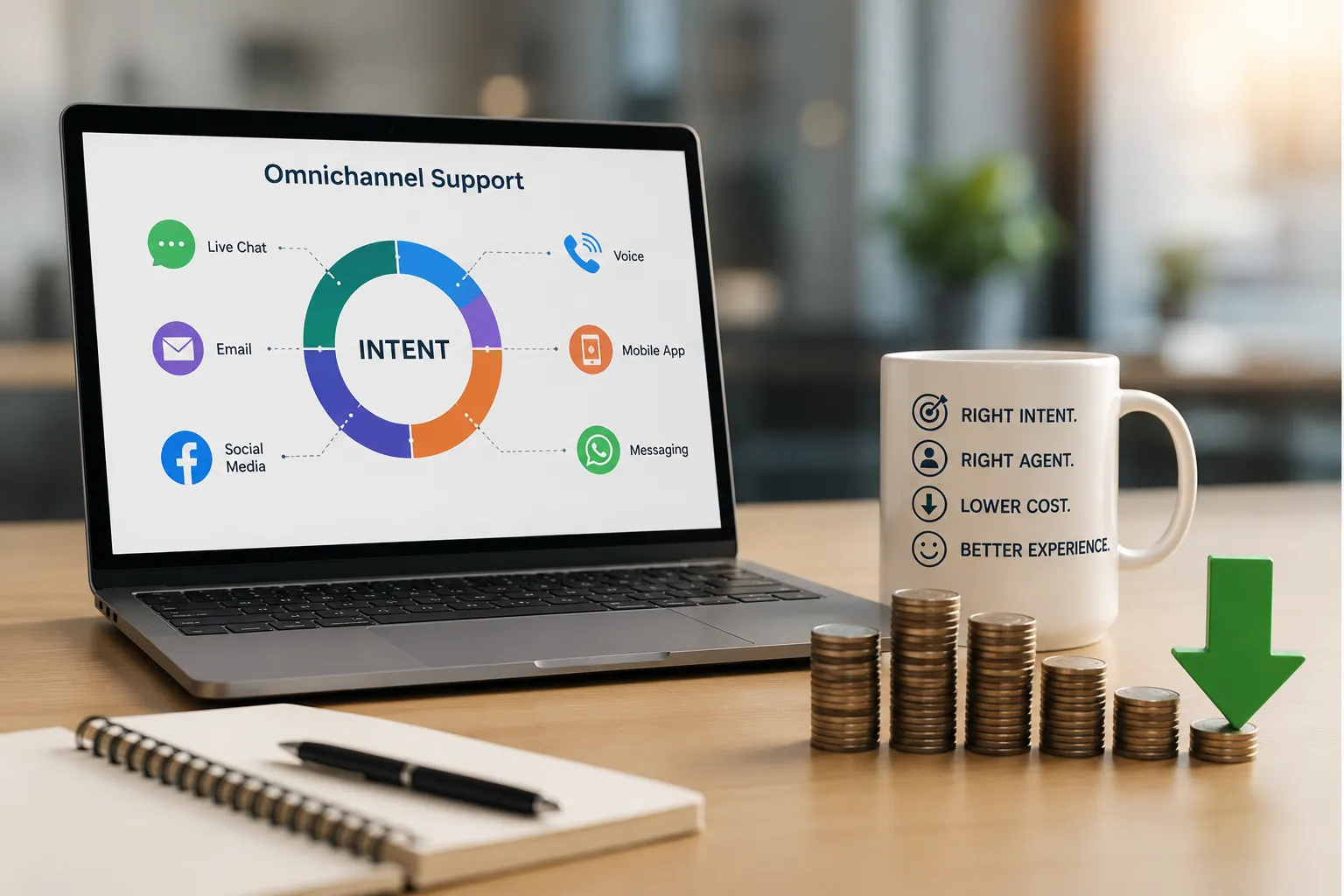
More than half of customers, 56%, say they have to repeat themselves during support interactions because context does not travel with them across channels or teams. That is not only a customer experience problem. It is also a cost problem.
A customer emails about a delayed order. The reply comes from a generalist who checks the delivery status, sees a billing hold underneath it, and passes the case to a second team. The customer repeats the story. A third agent closes the case two days later. Nobody did their job badly. The support model made the customer pay for the gaps between teams.
The channel a customer picks has little to do with what it costs to serve them. The bigger question is whether the system understands what they need before it decides who should answer. Many organisations have solved the channel problem but left the routing problem untouched. That is where cost still leaks.
The Difference Between Multichannel, Omnichannel, and Intent-Routed Support
The three terms get used interchangeably in vendor decks. They describe genuinely different operating models, and the difference matters because two of the three still route on the wrong variable.
| Dimension | Multichannel | Omnichannel | Intent-Routed |
|---|---|---|---|
| Channels available | Phone, email, chat, social | Phone, email, chat, social | Phone, email, chat, social |
| Customer history shared | No | Yes | Yes |
| Routing logic | Channel | Channel or skill | Intent + context + priority |
| Agent sees full context | No | Yes | Yes, with detected intent |
| CSAT benchmark | 28% (Plivo) | Higher than disconnected multichannel | Designed to improve resolution and reduce friction |
| Primary cost driver | Transfers and repeat contacts | Skill mismatch and inefficient queues | Right agent, automation, and priority at first touch |
Multichannel - Every Channel Exists, None Talk to Each Other
Multichannel support means a customer can reach a business by phone, email, chat, and social media, but each channel runs its own queue and history. A customer who calls after emailing may be treated as a new contact. A simple example: a customer calls Emirates about a baggage claim after emailing the day before. The phone agent has no record of the email. The customer explains everything again. Disconnected multichannel support sits at just 28% CSAT
Omnichannel - Channels Share Context but Routing Is Still Channel or Skill-Based
Omnichannel support fixes the memory problem. An agent can see the full conversation history regardless of which channel it happened on. What it usually does not fix is the assignment logic underneath. Most deployments still send all chats to the chat team and all calls to the phone team, or route by skill group set months in advance. Shared history helps once a case has landed with an agent. It does nothing to decide whether that agent should have received it.
Intent-Routed - The System Reads Intent Before Deciding Where the Contact Goes
Intent-based routing inserts one step before assignment: the system reads the opening message, classifies what the customer is actually trying to do, and only then decides the queue, agent, or automation. Channel becomes an input, not the decision. A billing dispute raised over chat and the same dispute raised by phone end up with the same team, at the same priority because the intent decided the route, not the channel it arrived on.
You Think You Have Omnichannel - How to Tell If Your Routing Is Actually Intent-Based
| Question | If Yes → Intent Routing | If No → Channel Routing |
|---|---|---|
| Does the system classify what the customer needs before assigning an agent? | Intent is an input to the route. | The channel or queue is the main input. |
| Can the same intent reach the same specialist across voice, chat, email, and social? | Intent follows the customer across channels. | Each channel keeps its own route. |
| Does routing use customer value, urgency, or sentiment with intent? | Context changes priority and assignment. | The request is routed without enough context. |
| Can simple intents move to self-service or AI before a human queue? | Low-complexity work is deflected. | Every request enters a human queue. |
| Is agent performance measured per intent category, not blended? | Coaching and cost are tied to intent. | A single blended average hides intent-level gaps. |
Shared history does not automatically mean intent routing. Use these five questions to see whether your operation routes by what the customer needs or by the channel they chose.
Why Channel-Based and Skill-Based Routing Cost More Than You Think
Channel and skill routing are not badly designed. They are just answering the wrong question. And the cost they generate shows up in three distinct places, not one.
Repeat Transfers and Wrong-Team Handoffs
Handling Cost = transfers and wrong-team handoffs. When routing logic only knows the channel, it cannot tell a two-minute password reset from a complex contract dispute arriving down the same line. Both land with the same first-line team, and the complex case gets transferred once the agent finds it is outside their remit. Every transfer adds hold time, another agent's handling time, and risk of lost context. Only 13% of companies say customer data and history carry over completely across interactions
Over-Skilled Agents Handling Under-Skilled Work
Skill Cost = over-skilled agents doing under-skilled work. A senior specialist trained for escalations may spend part of the day answering "where is my order" because the ticket landed in a general queue. That is expensive labour doing simple work, even when the ticket closes on time.
Worked example: If a Tier 2 agent costs $28/hour and spends 30% of their day on "where is my order" queries that a Tier 1 agent could handle at $12/hour, the avoidable cost is $16 per hour for that work. On a 50-agent team, assuming 2,080 paid hours per agent each year, that is $499,200 in annual labour waste.
Trust Cost = customers repeating themselves. Every repeated explanation costs agent time twice: once to hear it, and again to rebuild confidence with a customer who is now more frustrated. At 56% of customers repeating themselves during support interactions (Source: Plivo), this is not an edge case.
The third cost is a trust cost. Every repeated explanation costs agent time twice once to hear it, once to rebuild confidence with a customer who is now visibly more frustrated than they were on the first attempt. At 56% of customers repeating themselves during support interactions, this is not an edge case. It is closer to the default experience wherever routing carries the channel forward but not the context.
How Intent-Based Routing Actually Works in 2026
Worked example: Customer message: “I was charged twice and I want to cancel.” Classifier output: Primary Intent = Billing Dispute; Secondary Intent = Cancellation Risk; Sentiment = Frustrated; Confidence = 0.92. Routing: Skip generalist queue → billing specialist with retention training.
Solving handling cost, skill cost, and trust cost at the same time requires the system to know what the customer wants before a human ever sees the case. That happens in four stages, usually within a second or two of first contact.
| Same Intent but Different Context | Routing Decision |
|---|---|
| New customer with a first billing dispute | Route to a billing specialist or assisted billing queue; keep the priority standard unless urgency or sentiment is high. |
| 5-year customer with a billing dispute | Route to a billing specialist with loyalty context visible; raise priority if the account history shows high value or repeated issues. |
| Enterprise account with its 3rd billing contact this month | Bypass the standard queue; route to a senior billing or account specialist with escalation and retention context. |
NLP and Intent Classification at First Touch
The system reads the opening message, spoken or typed, and classifies what the customer wants using natural language processing. Salesforce frames this as the first step in modern routing: detect the channel, then use NLP to work out whether the customer needs an order update, is reporting a problem, or wants technical support, before the interaction goes anywhere
Contextual Data Enrichment (CRM, Order, Loyalty, Sentiment)
Intent by itself is a partial picture. The system layers in what it can see about the account order history, loyalty tier, open cases, and a read on sentiment or urgency, sometimes triggered by specific language such as "cancel". A billing question from a high-value account and the same question from a new customer can reasonably take different paths from here, and should.
Real-Time Priority Scoring and Routing Decisions
Intent and context combine into a priority score. Urgent, high-value, or high-risk contacts move ahead of routine ones even if they arrived later the same logic behind priority-based routing generally, which ranks work by business value rather than treating every contact as first-come, first-served
Human + AI Agent Selection Logic
| Savings Mechanism | Source | Reported Impact |
|---|---|---|
| Fewer transfers / faster resolution | Zendesk via Plivo | 31% reduction in first-resolution times; 39% lower customer wait times |
| Self-service and digital deflection | Plivo citing Odondo | 25–35% reported cost reduction from digitising service delivery |
| Integrated omnichannel routing | Plivo citing Deloitte Digital | 9% reduction in cost per assisted contact |
| Wider service transformation | Plivo citing McKinsey | 3–7% reduction in overall service delivery cost |
The system then decides who should take the contact. A routine, low-complexity intent can go straight to an AI agent capable of resolving it end to end. A complex or sensitive intent goes to a human with the right skill match. If an AI agent hits its limit mid-conversation, the case escalates to a person without losing the context already gathered. Voice support outsourcing can use the same intent-based approach, ensuring voice contacts reach the appropriate human or AI agent. None of this removes the need for judgement - it decides faster who should be exercising it.
Worked example: A 500-agent operation handles 1.5 million contacts a year at an average assisted cost of $4 per contact. That is $6 million in annual assisted-contact cost. A 9% reduction would save about $540,000 a year. A 20% reduction would save about $1.2 million. These are scenarios, not a promised result; actual savings depend on transfer volume, automation, staffing mix, and rollout depth.
The Cost Math: Where the 9–35% Savings Actually Come From
The commonly cited savings range for connected, intent-aware service is not a single figure from one study. It is a band built from several places where the three costs named earlier — handling, skill, and trust actually leave the system.
Fewer Transfers = Lower Average Handle Time
Companies running an integrated, connected support model see a 31% reduction in first-resolution times and a 39% decrease in customer wait times compared to teams operating in channel silos. Fewer wrong-team handoffs is a large part of why. This is the handling cost being closed.
Higher First Contact Resolution = Fewer Recontacts
When the first agent or AI agent to touch a case is also the right one, resolution happens without a second or third contact. Every avoided recontact is a ticket the team never has to staff for — a direct reduction in volume, not just in average handling time.
Better Deflection to Self-Service on Simple Intents
Once a system can reliably classify a "where is my order" or "reset my password" intent, it can resolve it through self-service or an AI agent before a human queue ever sees it. A meaningful share of the reported 25–35% cost reduction from digitising service delivery originates here.
Right-Skilling Agents to Right-Complexity Contacts
| Intent Category | Examples | Ideal Handler | Escalation Trigger |
|---|---|---|---|
| Transactional | Order status, password reset, policy lookup | AI agent, self-service, or Tier 1 | Low confidence, exception, or customer asks for a person |
| Servicing | Booking change, address update, subscription modification | Tier 1 servicing agent | Identity issue, policy exception, or complex account change |
| Sales | Pre-purchase enquiry, upsell trigger, cart recovery | Commercially trained agent or sales queue | High-value opportunity or complex product need |
| Complaint | Damaged item, failed delivery, escalation | Senior customer care or complaint specialist | Repeat complaint, high-value account, or retention risk |
| Distressed | Emotional, vulnerable, or high-value customer situation | Senior or specially trained agent | High sentiment risk, vulnerability, or executive-level concern |
A support channel is not meant to double as a sales desk, but pre-purchase questions and abandoned-cart follow-ups arrive there anyway. Routing these to a commercially trained agent, instead of a general queue, turns a cost centre contact into a revenue conversation.
Complaint - Damaged Item, Failed Delivery, Escalation
These carry reputational and retention risk and need a human who can exercise judgement, not follow a script. Misrouting a complaint into a generalist queue is one of the more expensive failures on this list, because it stacks a transfer on top of a customer who is already unhappy. This is standard complaint handling done wrong. Complaint management services include intelligent routing based on priority and type, escalation management, sentiment detection, and complaint tracking.
| Component | You Have It If… | You Don't Have It If… |
|---|---|---|
| Unified data layer | Order history, tickets, loyalty, and channel history can be queried in one place in real time. | Each channel or system holds separate customer history. |
| Intent classifier | Incoming messages get an intent label and confidence score within seconds. | Agents or rules depend mainly on channel, manual tags, or fixed categories. |
| Routing engine | Intent, urgency, customer value, and business rules decide the next queue, agent, or AI. | Queues are fixed by channel or old skill groups. |
| Agent desktop | The agent sees intent, account context, and prior history before or at answer. | The agent must open multiple systems or ask the customer to repeat the story. |
Distressed - Emotional, Vulnerable, or High-Value Customer Situations
Distinct from a standard complaint. Tone, sentiment, or account value signals that scripted handling is the wrong approach here. These should bypass the standard queue entirely and go straight to a senior or specially trained agent.
What Intent-Based Routing Requires From Your Tech Stack
None of the above works without infrastructure built for it. Four components tend to be non-negotiable, and skipping any one of them quietly caps how much of the savings range above is actually reachable.
Unified Customer Data Layer Across Channels
Intent classification is only as good as the data behind it. Order history, past tickets, loyalty status, and product usage need to sit in one place the routing engine can query in real time, not scattered across separate systems per channel.
NLP or LLM-Based Intent Classifier
The engine that reads the incoming message and assigns it to an intent category with a confidence score, ideally within the first few seconds of contact.
Routing Engine With Real-Time Priority Rules
A rules layer that takes the classified intent, adds urgency and customer value, and decides where the contact goes — a specific agent, a skill group, an AI agent, or a queue.
Agent Desktop That Shows Intent and Context at Answer
The classification is wasted if the agent who receives the contact cannot see it. A unified agent desktop that surfaces the detected intent, account context, and prior history the moment the agent answers is what turns an accurate routing decision into an experience the customer actually notices.
The Organisational Change That Actually Makes Intent Routing Work
Worked example: Suppose 10,000 transactional intents cost $2.20 each to resolve, while 2,000 complaint intents cost $9.00 each. Transactional resolution costs $22,000 and complaint resolution costs $18,000. If complaint cost rises to $11 because of transfers, the extra $4,000 is visible at the intent level even if the blended cost per contact barely moves.
Technology decides where a contact should go. It does not decide whether the team receiving it is organised to act on that decision and this is usually where rollouts underperform their business case.
Redefining Agent Skill Groups Around Intent, Not Channel
Skill groups built around "chat team" and "phone team" do not map onto intent-based routing. Teams that get the full value tend to rebuild groups around intent categories instead - billing and servicing, complaints and escalations, sales-adjacent regardless of which channel the contact arrived on.
Measuring Cost Per Resolved Intent, Not Cost Per Contact
Cost per contact treats every ticket as equal, which is precisely the assumption that made channel routing expensive in the first place. Cost per resolved intent shows whether a transactional request is being handled as cheaply as it should be, and whether a distressed or complaint intent is getting the attention it needs without over- or under-spending on either.
Coaching Agents Based on Intent-Level Performance
Reviewing performance by intent category, rather than as one blended average, shows where an agent is strong and where a specific intent type consistently runs long or gets escalated. That is a sharper approach to measuring customer support KPIs than relying on a single handle-time number that hides both good and bad performance inside the same figure.
Common Failure Modes When Rolling Out Intent-Based Routing
Intent routing fails in a small number of predictable ways. None of them are really technology failures.
Under-Trained Intent Models That Misclassify
A classifier trained on too little historical data, or on the wrong customer base, misroutes contacts confidently and quietly. Misclassification can look like the system is working right up until complaint volume in the wrong queue starts climbing — by which point it has been running wrong for weeks.
1Point1 operates intent-based omnichannel support as a combination of people, process, data, and contact-centre technology. Its public materials show integrations with Salesforce, Zendesk, Freshdesk, and Genesys, while its technology roles also reference platforms such as Genesys Cloud, NICE CXone, Amazon Connect, Cisco Contact Center, Avaya, and Five9. This points to a multi-platform environment rather than a single CCaaS stack. 1Point1 also describes AI-powered ticket routing, with automated categorisation based on intent and urgency, plus self-service and intelligent bot flows.
A practical deployment can start with the five top-level intent categories used in this model: Transactional, Servicing, Sales, Complaint, and Distressed. The exact intent taxonomy should be set per client, product, and contact volume. Classifier tuning is continuous: models are trained and refined against real ticket history, misroutes, new customer language, and changes in the journey. 1Point1's role is not only to configure the technology but also to keep the routing logic, agent skill groups, and coaching model aligned as intent patterns change.
A model that classifies intent correctly but ignores tone or account value will still send a furious, high-value customer into a standard queue because their stated request looks routine on the surface. Intent without context is only half the decision Salesforce describes when it treats context evaluation as a distinct step from intent detection, not an optional add-on.
Agent Groups Not Restructured to Match New Routing Model
The most common failure is not technical at all. A business installs a classifier and a routing engine, then leaves agent skill groups organised around channels exactly as they were. The system routes correctly. The team receiving the contact was never rebuilt to handle it that way, and the benefit of an accurate routing decision gets lost at the very last step — the one step that costs nothing to fix and is the one most rollouts skip.
Where 1Point1 Fits in an Intent-Based Omnichannel Model
For a BPO partner running support at meaningful scale, intent-based routing is less a software feature than an operating discipline, and the discipline is where most of the value actually gets captured or lost. 1Point1 works with clients on the layer that makes intent routing pay off in practice: unifying customer data across channels, training and continuously tuning intent classifiers against real ticket history and restructuring agent skill groups and coaching models around intent categories rather than channels. The technology can tell you where a contact should go. Whether that decision saves money depends on whether the operating model receiving it was built to act on it.
Conclusion
The channel a customer chooses was never really the variable driving cost. What decides cost is whether the system understood the request before deciding who should handle it. Channel and skill routing get a contact to a queue. Intent routing gets it to the right queue on the first attempt, which is exactly where the transfers, the recontacts, and the wasted specialist hours stop accumulating. The 9–35% range is wide because rollouts differ in depth, but the direction holds across every source cited here: teams that route by intent spend less to resolve the same volume, and their customers stop having to explain themselves twice to get there. Getting from the technology decision to the savings number is an operating model question as much as a software one which is the part of this shift connected support model 1Point1 spends most of its time on.