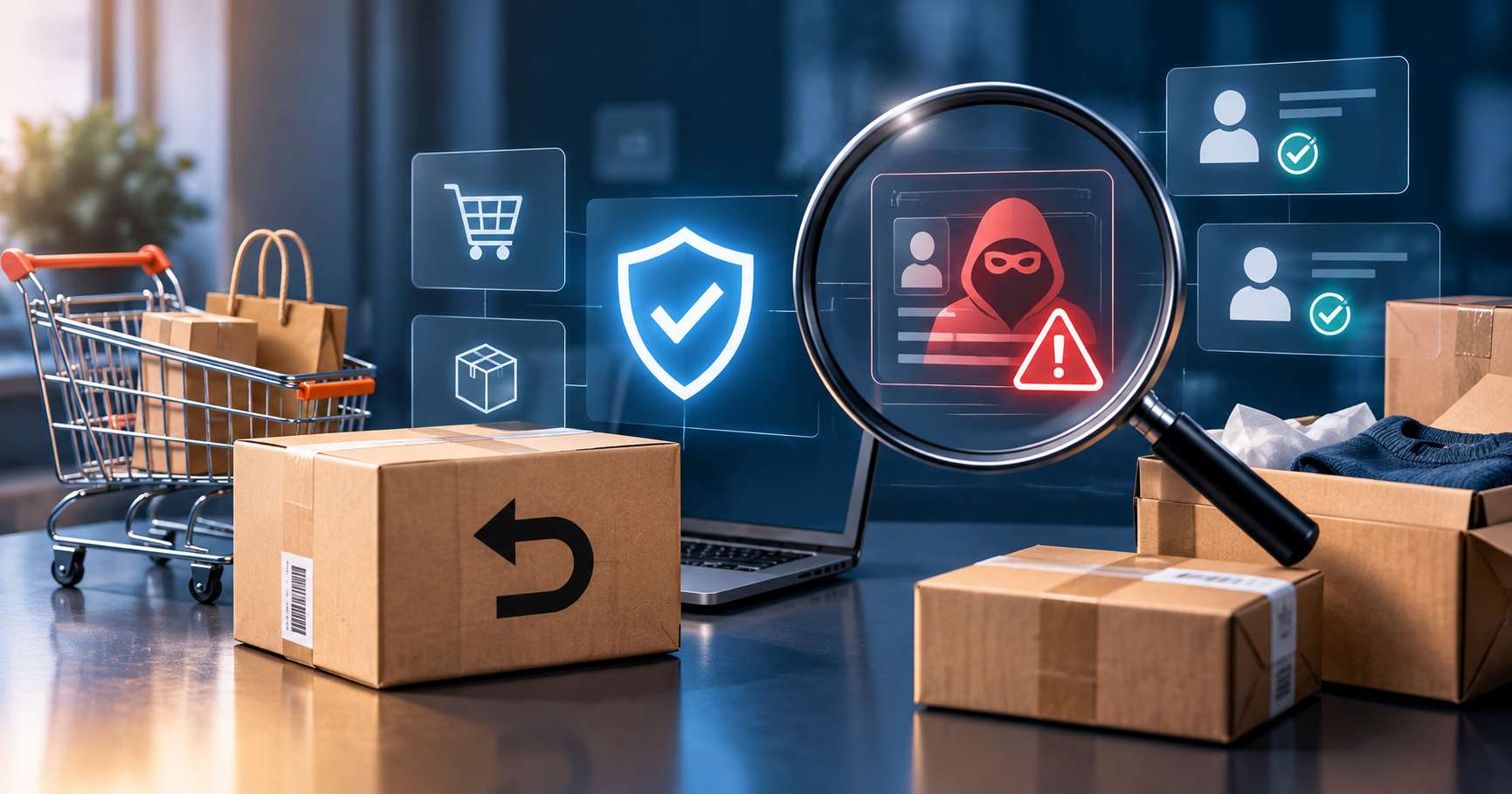
Return fraud cost US retailers an estimated 101 billion dollars in 2023 [source]. That figure is projected to exceed 115 billion by 2026. An estimated 15.14% of US retail returns in 2024 were fraudulent or abusive, costing 103 billion dollars, according to Appriss Retail and Deloitte [source]. These numbers get cited constantly. What gets discussed far less is how detection actually works underneath the marketing language. There is an uncomfortable reality beside it too: retailers getting this wrong are not just failing to catch fraud. They are wrongly flagging their most loyal, highest-margin customers.
This is not another definitions list. It covers the detection mechanics, the data stack behind real-time decisioning, the tiered response model, and the false-positive problem most fraud discussions skip entirely.
The Ecommerce Return Fraud Typology at a Glance (And What's Missing From Most Discussions)
Six Fraud Categories in One Table — Wardrobing Detection, Bracketing, Empty-Box, Switch, Receipt Manipulation, Organised Rings
| Fraud Type | What Happens | Typical Signal |
|---|---|---|
| Wardrobing | Item is used once, then returned as new | Return shortly after high-use-window events; tags reattached |
| Bracketing | Multiple sizes or colours ordered with intent to return most | High per-order SKU variance on the same product |
| Empty-box | Packaging returned with nothing inside, or wrong weight | Return package weight mismatch against expected item weight |
| Switch fraud | A cheaper or broken item substituted for the original | Serial number or item mismatch on inspection |
| Receipt manipulation | Falsified or reused receipts used to extract refunds | Duplicate receipt numbers or altered purchase dates |
| Organised rings | Coordinated fraud across multiple accounts or addresses | Shared address, device, or payment method across “unrelated” accounts |
Why the Category List Alone Does Not Help You Detect Anything
Knowing wardrobing detection exists does not tell an operations team how to spot a genuine case. It will not help them tell a wardrobing account apart from a customer who legitimately changed their mind after one wear. The category list is a glossary, not a detection system. Treating it as one is why so many retailers stall at policy tightening instead of building real detection capability.
What This Article Covers That Category Definitions Do Not
The sections that follow cover the actual signals, data infrastructure, and decisioning logic. This is what separates a genuine fraud detection programme from a list of suspicious behaviours nobody has built the capability to act on.
How Modern Return Fraud Detection Actually Works Under the Hood
Behavioural Signals — Return Frequency, Basket Composition, Session Data
Serial returners represent only 5 to 10% of a brand's customer base. They account for 30 to 40% of all returns [source]. Behavioural signals form the first and most accessible detection layer. Return frequency, unusual basket composition, session-level browsing. This data already lives inside the retailer's own systems.
Device, IP, and Address Graph Intelligence
Organised fraud rarely operates through a single account. Mapping shared devices, IP addresses, and shipping addresses across accounts that present as unrelated surfaces coordinated abuse. Reviewed individually, each account would look isolated and unremarkable.
Payment and Refund Route Analysis
Track the payment method used for purchase against the route requested for refund. Flag mismatches, like refunds consistently requested to a different instrument than the original payment. This adds a financial-layer signal that behavioural data alone does not capture.
Image and Document Verification at the Return-Initiation Step
Require photo evidence for damage claims at the moment a return is initiated, not after the item has shipped back. This deters casual false-damage claims. It also gives the detection system a verifiable data point to weigh against the rest of the account's behavioural profile.
Machine-Learning Scoring Models — Features, Training Data, Model Drift
Modern fraud scoring models combine behavioural, device, payment, and verification signals into a single risk score. They train on historical confirmed-fraud and confirmed-legitimate cases. These models need ongoing retraining as fraud tactics evolve. A model trained on last year's patterns will drift out of alignment with how fraud actually presents this year.
The Data Stack That Powers Return Fraud Detection in 2026
Order, Payment, and Return History as a Unified Customer Record
Fraud detection is only as effective as its ability to see a customer's full history in one place. When order, payment, and return records sit in disconnected systems, teams end up cross-referencing manually. That does not scale past a small transaction volume, which is exactly why most fraud hides in the volume that makes a business efficient in the first place.
First-Party Behavioural Data From Site and App Sessions
Session-level data adds a pre-purchase signal layer that post-purchase order history cannot provide on its own. How a customer navigates before purchase. How quickly they add multiple sizes to cart. This catches bracketing intent earlier than a return-history-only model would.
Third-Party Identity, Device, and Address Verification Signals
External identity and device intelligence services fill a gap first-party data cannot close alone. They confirm whether a shipping address has a known history of fraud across multiple retailers. No single retailer's internal data would ever reveal that on its own.
Real-Time Decisioning at the Return-Request Point (Not Post-Warehouse)
The highest-leverage detection point is the moment a return is requested. Not after the item has shipped back and gone through the warehouse. Real-time decisioning at request time lets the retailer apply the right response tier immediately [source]. That beats discovering fraud after the processing cost is already spent.
The Four-Tier Response Model — What to Do With a Flagged Return
| Tier | Action | When to Apply | Risk If Misapplied |
|---|---|---|---|
| Tier 1 | Allow with standard refund | Low or no risk signal | Applying scrutiny here damages honest customer relationships |
| Tier 2 | Allow with manual review or photo verification | Moderate, inconclusive risk signal | Too much friction here slows down genuine customers unnecessarily |
| Tier 3 | Restrict to store credit, alternative refund route, or restocking fee | Higher risk, not yet conclusive fraud | Applied too broadly, it punishes legitimate bracketing as if it were abuse |
| Tier 4 | Decline and escalate to investigation | Highest-confidence signal, corroborated by multiple data points | Applied without strong evidence, it ends a customer relationship over a false positive |
Tier 1 — Allow With Standard Refund
Most returns, including most flagged as mildly elevated risk, should move through standard refund processing without friction. Over-applying scrutiny at this tier is the fastest way to damage the honest customer relationships that generate the bulk of legitimate revenue.
Tier 2 — Allow With Manual Review or Photo Verification
Returns with a moderate risk signal proceed, but with an added verification step. Usually photo evidence or a brief manual review. This adds minor friction without an outright denial.
Tier 3 — Restrict to Store Credit, Alternative Refund Route, or Restocking Fee
Higher-risk returns can be approved but restricted. Refunded as store credit rather than original payment, or subject to a restocking fee. This discourages abuse while still honouring the transaction.
Tier 4 — Decline and Escalate to Investigation
Reserved for the highest-confidence fraud signals, usually corroborated by multiple independent data points. This tier declines the return and routes the case to a dedicated investigation function. It is the right response only when the evidence genuinely warrants it.
How to Set the Tier Thresholds by Category, Order Value, and Customer Segment
Threshold calibration should vary by product category. Apparel bracketing looks structurally different from electronics switch fraud. It should vary by order value too, since the cost-benefit of manual review shifts at higher price points. And by customer segment, since a long-tenured high-LTV customer warrants a different threshold than a new account with no purchase history.
The False-Positive Problem - Where Fraud Detection Costs You More Than the Fraud
Legitimate Repeat Returners Who Are Actually High-Margin Customers
A customer who orders multiple sizes to try at home, then keeps and pays for most of them, is not the same risk profile as a return policy fraud account. Both show elevated return frequency. Detection systems that cannot tell the two apart alienate exactly the shopping behaviour many apparel brands want to encourage.
Category-Driven Bracketing (Apparel Sizing) Miscategorised as Abuse
Bracketing driven by a retailer's own inconsistent sizing, not deliberate abuse, is a merchandising problem misread as a fraud problem. Flagging these customers treats poor size guidance as dishonest behaviour. It usually is not.
Sizing-driven bracketing is frequently a merchandising fix, not a fraud fix. A detection system that cannot see that distinction will keep flagging customers for a problem the size chart created.
The Cost of a Wrongly Denied Refund on Lifetime Value
A single wrongly denied refund does not just cost the disputed transaction. It frequently ends the customer relationship entirely. Years of potential future purchases convert into permanent churn, and increasingly, a public complaint that damages trust with prospective customers watching.
How to Measure and Manage the False-Positive Rate as a KPI
False-positive rate deserves the same ongoing measurement discipline as the fraud catch rate. Leading AI-based systems have driven false-positive rates down significantly versus legacy rule-based systems [source]. Tracking this number quarterly, not just fraud caught, keeps a programme from quietly becoming a customer-alienation programme.
The Refund Fraud Detection CX-Side Workflow Nobody Talks About - Communicating a Refund Denial
Agent Scripts for a Denied or Restricted Refund
Agents handling a Tier 3 or Tier 4 conversation need language that explains the restriction factually, without accusation. The customer on the other end of that call may well be entirely legitimate. They may simply be caught by a pattern that resembles abuse.
The De-Escalation Playbook for a Flagged Legitimate Customer
A structured de-escalation path prevents a false-positive case from becoming a public dispute. Acknowledge the customer's frustration. Explain the review process without over-justifying the flag. Provide a clear timeline for resolution.
Manual Review Turnaround Time SLA
A defined SLA for manual review, ideally measured in hours rather than days, matters enormously to a legitimate customer waiting on a refund decision. A slow review process punishes honest customers with the same delay, whether the case is eventually approved or denied.
When to Reverse a Denial and How to Do It Without Losing Trust
When new information overturns an initial denial, the reversal needs to be prompt. Pair it with a genuine acknowledgement, not a silent correction. How a brand handles being wrong often determines whether the customer relationship survives the flag at all.
Escalation Path to Investigation and Legal Review
Confirmed high-confidence fraud, particularly organised ring activity, needs a defined path to investigation. Where warranted, that includes legal review, separate from the standard customer service escalation chain that handles ordinary disputes.
How Return Fraud Detection Integrates With Contact Centre and Back-Office Ops
Agent Workflows for Escalated Return Requests
Contact centre agents need direct visibility into a case's risk tier and the specific signal that triggered it. Not just a generic flag. That way they can have an informed conversation, rather than reading from a script disconnected from the actual reason for the review.
Back-Office Investigation and Case Management
Escalated cases need a dedicated case management workflow. Track evidence, decisions, and outcomes in a system built for investigation. Not buried inside a generic customer service ticket queue where the context gets lost.
Feedback Loop From Investigation Outcomes Back Into the Detection Model
Every investigated case, whether confirmed fraud or confirmed false positive, is training data. Feeding these outcomes back into the scoring model keeps the detection system improving, rather than drifting further from accuracy over time.
Cross-Functional Ownership Between Loss Prevention, CX, and Merchandising
Return fraud detection sits at the intersection of loss prevention, customer experience, and merchandising.
Sizing-driven bracketing is frequently a merchandising fix, not a fraud fix.
Without shared ownership across these three functions, the programme tends to default to whichever team owns the technology. Usually loss prevention. That comes at the expense of the customer experience and merchandising context that should inform it.
The Return Fraud Analytics That Prove Detection Is Actually Cutting Losses (Without Costing Customers)
| Tier | Action | When to Apply | Risk If Misapplied |
|---|---|---|---|
| Tier 1 | Allow with standard refund | Low or no risk signal | Applying scrutiny here damages honest customer relationships |
| Tier 2 | Allow with manual review or photo verification | Moderate, inconclusive risk signal | Too much friction here slows down genuine customers unnecessarily |
| Tier 3 | Restrict to store credit, alternative refund route, or restocking fee | Higher risk, not yet conclusive fraud | Applied too broadly, it punishes legitimate bracketing as if it were abuse |
| Tier 4 | Decline and escalate to investigation | Highest-confidence signal, corroborated by multiple data points | Applied without strong evidence, it ends a customer relationship over a false positive |
Fraudulent Return Rate Before and After Deployment
The clearest top-line indicator is the confirmed fraudulent return rate trend after deployment. Track it separately from the broader flagged-return rate. A flag is a suspicion. A confirmation is evidence.
Recovered Refund Value per Quarter
Quantify the dollar value of refunds prevented or recovered through detection, tracked quarterly. This connects the programme directly to the loss-prevention business case it was built to support.
False Positive Rate and Overturned Denial Rate
Track these two numbers alongside the fraud catch rate. Together they reveal whether the detection system is calibrated correctly, or simply aggressive, catching real fraud at the cost of flagging too many honest customers.
Net Impact on Customer Lifetime Value by Segment
The most sophisticated measurement connects fraud detection activity to downstream customer lifetime value by segment. It reveals whether flagged-then-cleared customers show any lasting drop in future purchase behaviour. That is the true cost of a false positive, and a fraud-catch-rate metric alone would never surface it.
What to Evaluate in a Return Fraud Detection Partner or Platform
Detection Signal Coverage (Behavioural, Device, Payment, Image)
Confirm the platform genuinely combines behavioural, device and identity, payment route, and image verification signals. Relying on a single data category is not enough, since fraud tactics increasingly span multiple signal types at once.
Explainability of the Model's Decisions
A model that produces a risk score without a clear, human-readable explanation is hard to defend in a customer dispute. It is just as hard for an operations team to trust or override, even when the context genuinely warrants it.
Integration Depth With Your OMS, Ecommerce Platform, and Payment Gateway
Real-time decisioning depends on genuine, tested integration with the order management system, ecommerce platform, and payment gateway already in use. A generic compatibility claim is not the same as one validated against the specific stack.
Manual Review Team Access and Case Management UI
Confirm the platform gives the manual review team a usable case management interface, with the evidence and context needed to decide quickly. They should not have to reconstruct context manually across disconnected systems.
CX Team Enablement — Scripts, Handoff Design, and Denial Communication Support
The best platforms extend past the detection layer into CX enablement. Agent scripts, escalation design, denial communication support. This is what determines whether a flagged case is handled in a way that preserves the customer relationship or destroys it.
Where a CX and Back-Office Partner Fits Into a Return Abuse Prevention Programme
Detection technology is only one half of a working return fraud programme. The other half, agent scripts, de-escalation playbooks, manual review turnaround, and back-office case management, is where most internal teams are least resourced. 1Point1 builds and staffs that operational layer specifically. We write and train agents on the Tier 3 and Tier 4 denial scripts, run the manual review queue against a defined SLA, and manage the case documentation that feeds back into the detection model. Catching fraud and protecting genuine customers happen together under one team, not as a trade-off split across departments.
Conclusion
Return fraud detection done well is not a technology purchase. It is a coordinated programme spanning detection signals, tiered response design, contact centre enablement, and continuous false-positive measurement. Retailers who only build the detection layer end up solving one loss problem by creating another: alienated honest customers who were never the threat. Losses are running past 100 billion dollars annually, and false positives carry their own quiet cost to lifetime value. The programmes winning in 2026 treat both sides as equally important.
If your return fraud programme needs the operational layer, contact centre scripts, de-escalation workflows, and case management, that turns detection technology into outcomes without alienating honest customers, 1Point1 builds and runs that layer for enterprise retailers.
Visit https://www.1point1.com/ to talk to our team.

.webp)