The 7 Moments in the Traveler Support Journey Where CX Breaks Down
- How poor CX drives lost bookings, higher costs and lower loyalty
- How disruptions and service gaps affect traveler satisfaction
- How AI-powered support resolves issues faster and improves CX
- How travel brands can reduce churn and build lasting loyalty
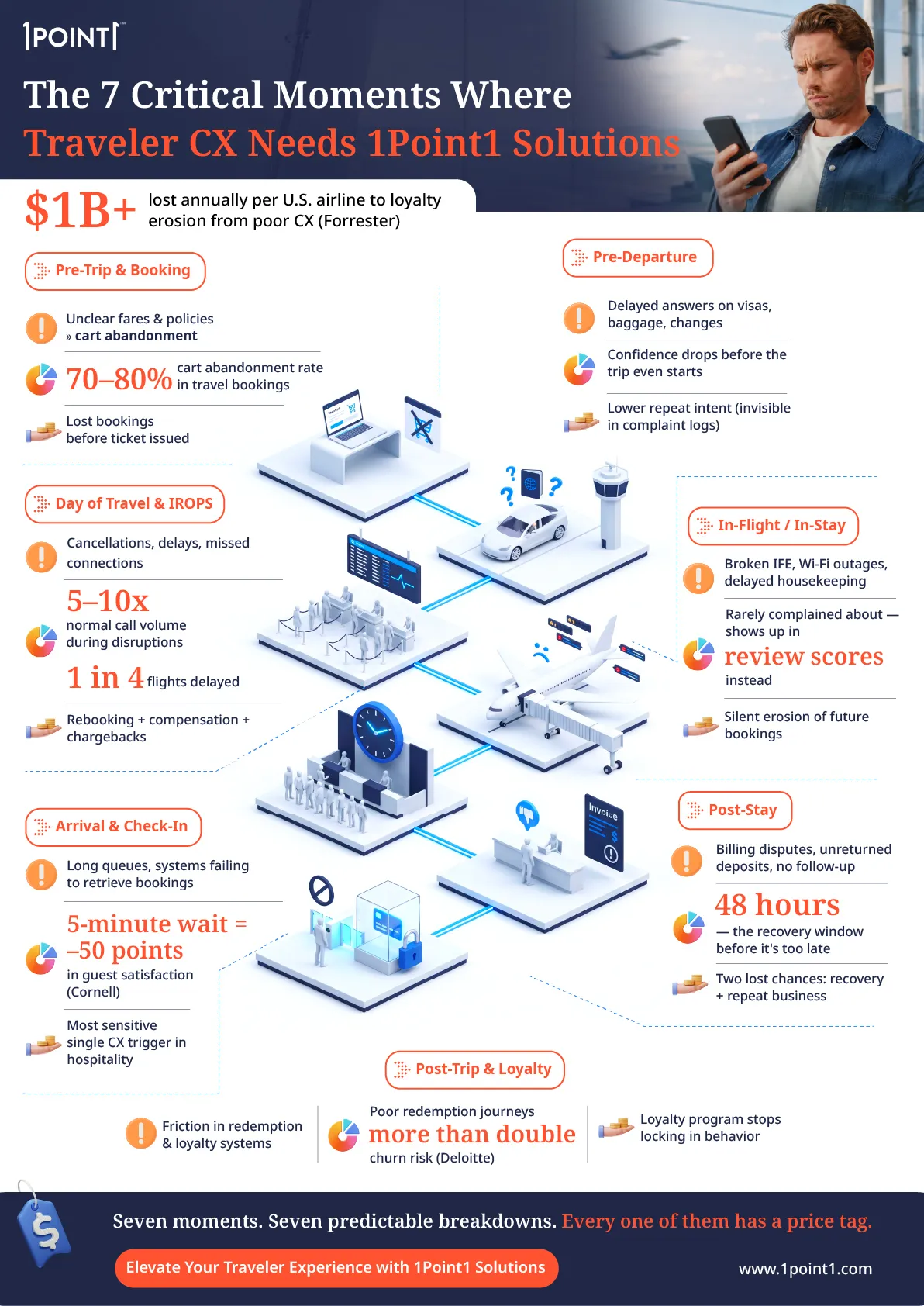
Why Every Breakdown in the Traveler Journey Has a Price Tag?
Most travel operators accept some level of service failure as inevitable. Planes get delayed. Hotels overbook. Baggage goes missing. What is not inevitable is the gap between the failure and response, and that’s where revenue disappears.
Multiple airline passenger studies consistently show disruption handling is one of the lowest-scoring CX moments. Many people never filed complaints. They just decided to choose a different brand next time. For travel operators, every CX breakdown has a financial footprint: lost bookings, chargebacks, agent time, compensation payouts and the compounding cost of loyalty erosion that shows up quarters later.
The journey from booking to post-trip has seven distinct moments where CX most commonly fails. Each one is predictable, preventable and directly tied to operator revenue.
The 7 Moments Where Traveler Support Fails
1. Pre-Trip and Booking
The journey breaks before it begins when travelers cannot get clear answers about fares, cancellation policies or itinerary modifications. Call queues spike during promotional periods, and self-service portals that cannot handle multi-leg bookings push customers to abandon carts entirely.
Across ecommerce benchmarks, cart abandonment consistently sits around 70–80%, with travel among the highest-performing abandonment categories. Operators that treat booking support as a cost center rather than a revenue function lose the customer before the ticket is even issued.
2. Pre-Departure
Between confirmation and travel lies a period of latent uncertainty. Visa documentation, baggage rules, special assistance, and itinerary changes typically surface here. When responses are delayed or inconsistent, confidence drops before the journey even begins. IATA’s global passenger research shows that the quality of communication before travel strongly influences overall satisfaction scores during and after the journey. Pre-departure friction rarely appears in complaint logs but instead shows up later in reduced satisfaction and lower repeat intent.
3. Day of Travel and IROPS
Irregular Operations (IROPS), covering cancellations, delays, diversions and missed connections, represent the highest-stakes CX moment in travel. U.S. DOT data shows on-time arrival rates typically fluctuate around 75–80%, meaning roughly1 in 4 flights may be delayed depending on the period.
When IROPS occurs, contact centres face five to ten times their normal call volume. Passengers who cannot reach an agent within the first thirty minutes of a disruption are significantly more likely to file a chargeback than those who receive proactive communication.
The cost compounds across:
- Rebooking expenses
- Compensation payouts
- Long-term loyalty loss caused by a single mishandled disruption
4. In-Flight and On-Route
Mid-journey support failures are often invisible to the operations team but highly visible to the passenger. Common issues include:
- Unanswered cabin requests
- Broken in-flight entertainment (IFE) systems
- Wi-Fi outages
- Meal service issues
While these may seem minor individually, together they erode the customer experience during the one period where the brand has a captive audience. For hotels, the equivalent is the in-stay experience, including:
- Delayed housekeeping
- Unresolved room issues
- Front desk teams overwhelmed during peak check-in
These failures rarely generate formal complaints but consistently appear in review scores, which directly influence future booking decisions.
5. Arrival and Check-In
The transition from transit to destination introduces another critical CX touchpoint. Common friction points include:
- Long check-in queues
- Reservation systems failing to retrieve bookings
- Staff unable to accommodate special requests
Cornell Hospitality Research shows that even a five-minute wait at hotel check-in can cut guest satisfaction by nearly 50 points, making queue time one of the most sensitive CX triggers in hospitality
6. Post-Stay
The 48 hours after checkout remain among the most underserved stages of the traveller journey. This is when guests commonly face:
- Billing disputes
- Incorrect charges
- Unreturned deposits
- Unanswered feedback requests
Operators that fail to close the loop during this period lose two critical opportunities:
- Recovering dissatisfied guests
- Converting satisfied guests into repeat customers
A follow-up arriving a week later might as well not arrive at all.
7. Post-Trip and Loyalty
Loyalty systems are meant to lock in repeat behaviour, but they break quickly when friction enters the experience. Deloitte research shows that poor redemption journeys and operational complexity significantly increase churn risk, in some cases more than doubling the likelihood of switching providers.
What These Failures Add Up to for Operators
Individually, each breakdown appears manageable. Collectively, they create a CX deficit that compounds across every booking cycle. Forrester estimates that poor CX and loyalty erosion can cost large U.S. airlines over $1B annually in lost value.
Hotel operators face similar exposure through OTA commission leakage when confidence in direct bookings declines. The cumulative cost is not merely financial. It is structural, steadily eroding the brand equity that supports pricing power in an increasingly commoditised market.
What a Dedicated CX Partner Does Differently
Travel CX failures follow patterns.
Patterns are solvable.
A dedicated CX partner provides:
- Surge-ready support capacity during IROPS
- Multilingual assistance across time zones
- AI-assisted triage that routes high-value passengers to human agents
- Closed-loop post-stay recovery workflows
The difference extends beyond technology. Instead, it lies in teams specifically trained on the traveler journey, with the domain expertise to distinguish between a routine rebooking and a high-risk churn signal.
Conclusion
The traveler journey contains seven predictable moments where CX most commonly breaks down, and each carries a measurable business cost.
Operators that treat these moments as isolated service failures will continue absorbing the financial consequences.
Those that recognize them as interconnected stages of the customer journey and invest in the capacity, technology and domain expertise needed to support travelers throughout the experience transform CX from a cost centre into a competitive advantage.
Let’s Connect

FAQs
The most common failures occur during:
- Booking (cart abandonment due to unclear policies)
- IROPS (surge demand exceeding agent capacity)
- Post-stay (billing disputes and unanswered feedback)
However, every stage of the traveler journey presents CX risks.
The financial impact varies by segment.
Forrester estimates the annual loyalty gap at over $1 billion per U.S. airline.
Hotel brands face similar costs through:
- OTA commission leakage
- Increased chargeback volume
- Reduced customer lifetime value caused by unresolved guest issues
Reactive support waits for passengers to report problems.
Proactive support identifies issues using operational data such as:
- Flight status updates
- Booking anomalies
- Review sentiment
The operator reaches out before the traveler contacts the brand.
Proactive support consistently reduces chargebacks while improving post-disruption loyalty and retention.