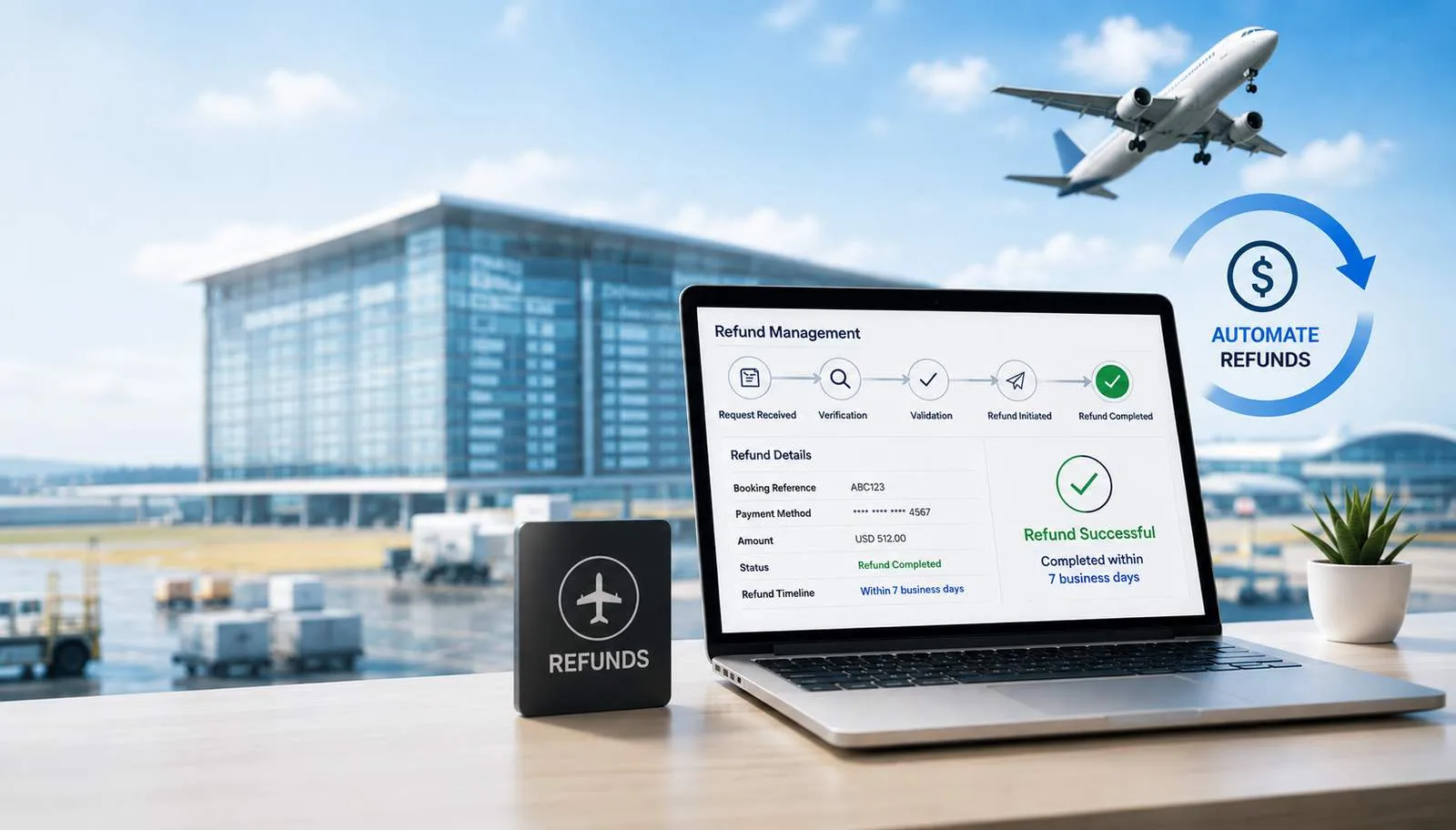
The U.S. Department of Transportation now requires automatic airline refunds within 7 business days for credit card payments. The EU mandates reimbursement within 7 days under Regulation 261/2004. For travel brands still process refunds manually, these aren't aspirational targets - they're legal deadlines.
A customer sees one transaction when a flight is cancelled and a refund is due. The request looks simple. The booking has a reference number; the payment method is known and the reason for the cancellation is recorded. Behind that request, however, the travel company may need to verify fare rules, ticket status, taxes, commissions, payment method, agency ownership and settlement data before the refund can be released.
That is why refund operations can become a very different problem from customer service. For an airline, OTA or travel agency, the customer may see one refund request while the back office sees several systems that need to agree before that request can be completed.
That makes refunds a strong candidate for automation. Not because every refund should be processed without human review, but because much of the work around a refund is repetitive, rules-based and spread across systems.
For travel brands, Travel Back Office Automation Services are therefore less about replacing service conversations and more about removing the manual work between a valid refund request and a completed financial transaction.
Why Refunds Are a Back-Office Problem, Not Just a Customer Service Problem
When a traveller asks, "Where is my refund?", the answer may sit somewhere between the front office and the financial back office. Travelport describes the back office around accounting records, management reporting, reconciliation, cash flow management and regulatory accounting, while its middle-office definition covers client and supplier information, cost analysis and service information.
Refunds touch both sides. The customer wants a clear answer. The business needs the underlying transaction to be correct. That distinction matters because adding more customer service agents does not necessarily make the underlying refund process faster.
An agent can explain why a refund is delayed. That does not make the refund process itself faster.
The Front Office Can Only Move as Fast as the Back Office Allows
A customer service team may have access to the booking record but still lack the information needed to complete a refund. The ticket may have been issued through a GDS. The payment may have gone through a card processor. The booking may have passed through an OTA. The refund may need airline approval.
IATA's BSP guidance shows how detailed the process can become. Agents must follow the airline's refund policy, use the original form of payment and, depending on the case, process the refund through the GDS or BSPlink. (Source: IATA, BSP Manual for Agents).
The customer sees one transaction. The back office sees a chain of dependencies.
Customer request → PNR lookup (GDS) → Ticket status (ticketing system) → Fare rules (policy engine) → Payment method (PSP) → Settlement (BSPlink) → Reconciliation (finance) → Customer notification
7 systems for one refund. The customer sees one transaction.
Refund Volume Is Only Part of the Problem
A high number of refunds can create pressure, but complexity is often the bigger issue. A straightforward cancellation with a known refundable fare is one kind of case. A partially used ticket with multiple payment methods, changed segments, commission implications and tax questions is another.
The second case needs more judgement. That means the best automation strategy does not try to remove human involvement everywhere. It removes repetitive work around the cases that are safe to automate and routes exceptions to the people who need to review them.
What Makes Travel Refund Processing So Difficult to Automate
Travel has a refund problem that many other industries do not. The transaction is rarely as simple as "customer paid, business refunds."
Multiple Systems Hold Different Pieces of the Same Transaction
A refund can involve a reservation system, ticketing system, GDS, payment platform, CRM, settlement platform and finance system. The relevant data may not line up cleanly across each one.
IATA says BSPlink consolidates amounts involved in agent and airline transactions and supports automated management of refunds and recovery of revenue reconciliation data.
This matters because automation works best when systems can exchange structured information. Without that foundation, employees end up acting as the integration layer.
Refund Rules Depend on the Booking
The correct refund can depend on the fare, route, ticket status, cancellation reason, carrier policy and payment method. IATA's guidance states that agents must follow the applicable airline refund policy and use the same form of payment as the original ticket when processing a refund.
That makes a simple "approve and pay" workflow risky. A good system needs to understand the conditions first.
A X-class fully refundable ticket can be refunded through the GDS with a single command. A W-class promotional fare on the same carrier requires airline authorization through BSPlink, a waiver code, and manual penalty calculation. Same airline, same route, completely different workflow determined by the fare basis code.
International Travel Adds Regulatory Complexity
The customer may be booking in one country, flying through another and purchasing from a company based somewhere else. Different jurisdictions can impose different requirements. This is one reason airline customer support outsourcing requires specialized knowledge of aviation workflows, regulations and policies.
For example, EU passenger rights provide for reimbursement within seven days in applicable cancellation cases, while U.S. rules set specific automatic refund timelines for covered flights and payment methods.
Why Travel Brands Should Automate Back-Office Refunds First
The strongest case for Travel refund automation is not simply speed. It is repeatability.
Refund operations contain many steps that happen again and again: identify the transaction, confirm eligibility, check the fare and ticket status, validate the refund amount, confirm the payment method, submit the transaction, update the relevant systems, reconcile the result and notify the customer.
A human does not need to make every decision in every step. Automation can handle the predictable work and allow people to focus on cases where judgement matters.
Automate Eligibility Checks Before Automating the Refund Itself
The first useful layer is decision support. A system can gather the booking information, ticket status, cancellation reason and payment details before presenting a case for action.
Routine cases can move through a defined workflow. Exceptions can be routed to a specialist. The result is not "AI refunds everything." The result is that humans spend less time assembling information and more time reviewing cases that genuinely need them.
Automate Refund Initiation for Rules-Based Cases
Once eligibility is established, the actual refund action can often be standardised. IATA describes BSPlink as supporting refund management and the financial processes between airlines and agents.
The more predictable the transaction, the stronger the automation case.
Other Back-Office Functions Worth Automating And Why Refunds Come First
Automate Reconciliation Too
A refund is not finished just because money has been sent. The transaction also needs to line up with the relevant booking, payment and settlement records.
IATA states that BSPlink supports automated recovery of revenue reconciliation data and automated management of refunds. (Source: IATA, BSPlink) This makes automated refund reconciliation an important part of the overall workflow rather than a separate finance task.
What Should Stay With Humans
Automation is most useful when it has boundaries. Travel brands should be cautious about fully automating cases involving disputed refund eligibility, complex itinerary changes, partially used tickets, multiple payment methods, unusual tax treatment, regulatory exceptions, suspected fraud and high-value corporate bookings.
IATA guidance also recognises cases that may require airline review or authorisation, including refund applications where an agent cannot process the refund directly through its normal GDS route.
The right model is therefore not automation versus people. It is automation for predictable work and humans for judgement-heavy work.
How Automation Changes OTA Refund Processing
OTAs add another layer because they often sit between the traveller and the airline or supplier. The OTA may own the customer relationship while the airline controls parts of the ticketing and refund process.
That creates handoffs. The OTA checks the booking, the airline may approve or process the refund, and the OTA must update its records and tell the customer what happened.
That creates handoffs. The OTA checks the booking, the airline may approve or process the refund, and the OTA must update its records and tell the customer what happened. These challenges are closely connected to AI and better customer experience, particularly when refund delays, unclear policies and dispute resolution can directly affect how customers perceive the brand.
Route Refund Cases Based on Ownership
Automation can route a refund to the OTA, airline or supplier before it reaches an agent. This cut wasted handling time and reduces wrong-team handoffs.
Track Refund Status Across the Journey
A good OTA workflow should show whether the refund is received, validated, submitted, approved, paid or blocked by an exception.
Clear status is as important as automation.
How Airline Refund Automation Fits Into the Wider Finance Operation
For airlines, refunds should not sit in isolation from settlement. The transaction eventually affects financial reporting, reconciliation and cash management.
IATA positions its financial services around payment, settlement and financial processes between airlines and travel agents, with BSPlink designed to simplify the movement of financial information and automate back-office functions. (Source: IATA, BSPlink).
That makes Airline refund automation more valuable when it connects the customer-facing workflow with the finance workflow. The goal is not simply to issue the payment faster. It is to maintain a reliable chain from refund request to settlement record.
Where Travel Mid-Office Automation Fits
The middle office connects booking activity with financial processing. It can hold supplier, cost and service information that a refund workflow needs.
A refund may start with a customer request but depend on data across the middle and back office.
What a Practical Refund Automation Workflow Looks Like
A practical workflow does not need to begin with a fully autonomous system. It can start with a clear sequence.
This sequence matters because automation is most effective when the entire process is designed around an outcome rather than around a single task.
How Travel Brands Should Measure Refund Automation
A refund automation programme should not be judged simply by how many refunds were processed automatically. That is an activity metric. The more useful measures are outcome-based.
Refund Turnaround Time: How long does it take from an eligible refund request to completion? The answer should be tracked by refund type and exception category. Benchmark: under 7 business days (DOT); under 72 hours for standard refunds.
Straight-Through Processing Rate: What percentage of eligible refund cases move through without manual intervention? This tells the organisation how much routine work has actually been removed. Benchmark: 60–80% for mature automation.
Exception Rate: How many cases fall outside the automated path? A high exception rate may mean the rules are too narrow or the underlying transaction data is inconsistent. Benchmark: under 25%.
Reconciliation Accuracy: How many refunds are matched correctly to their financial records? Automation that speeds up payment but creates reconciliation problems has only moved the workload. Benchmark: 99%+.
Repeat Contact Rate: How often does a customer contact the company again about the same refund? This connects back-office efficiency with customer experience. Benchmark: under 10%.
What Travel Brands Should Look for in an Outsourcing Partner
Automation does not always mean building everything internally. A travel brand may choose a partner that combines process expertise, technology and operational capacity. This becomes especially important during disruptions, where flight cancellation management may require coordinated automation, rebooking, refunds and customer communication.
The important questions are practical: Can the partner work inside the existing travel systems? Can it understand airline and agency refund rules? Can it separate routine refunds from exceptions? Can it support multiple markets and time zones? Can it reconcile transactions? Can it measure outcomes rather than just transactions handled? And can it provide human oversight when automation reaches a case it should not decide alone?
The right Travel back-office outsourcing model should make the operation easier to govern, not create another layer between the brand and the transaction.
Where 1Point1 Fits
1Point1 serves the travel sector across airlines, online travel agencies (OTAs), and corporate travel management firms (TMCs). Its travel operations cover booking and cancellation support, refunds, disruption handling, ticketing, GDS data management and back-office workflows.
Its airline operations work with GDS platforms such as Amadeus, Sabre and Travelport, along with airline-specific PSS and custom reservation or CRM systems. 1Point1 also uses Hybrid AI to automate routine travel workflows and route complex cases to trained specialists.
1Point1 does not publish a travel-only refund volume. Across the company, it states that it processes 200m+ transactions annually. For refund operations, the focus is clear: automate predictable work, keep exceptions with people, and connect the refund journey from booking to financial control.
Conclusion
Refunds look simple to travelers because they should. Behind the scenes, they often involve booking systems, ticket rules, payment methods, airline approvals, settlement processes and reconciliation.
That complexity is exactly why they are a strong candidate for automation. The best approach is not to remove humans from the refund process. It is to stop using humans for repetitive work that rules and systems can handle reliably.
For airlines, OTAs and travel companies, that means starting with the parts of the refund journey that are predictable, measurable and repeatable. Then connect those automated steps to human review for the cases that need judgement.
That is the difference between automating a task and redesigning an operation.
For travel brands dealing with growing transaction volumes, tighter refund expectations and increasingly complex back-office workflows, the second matters far more.