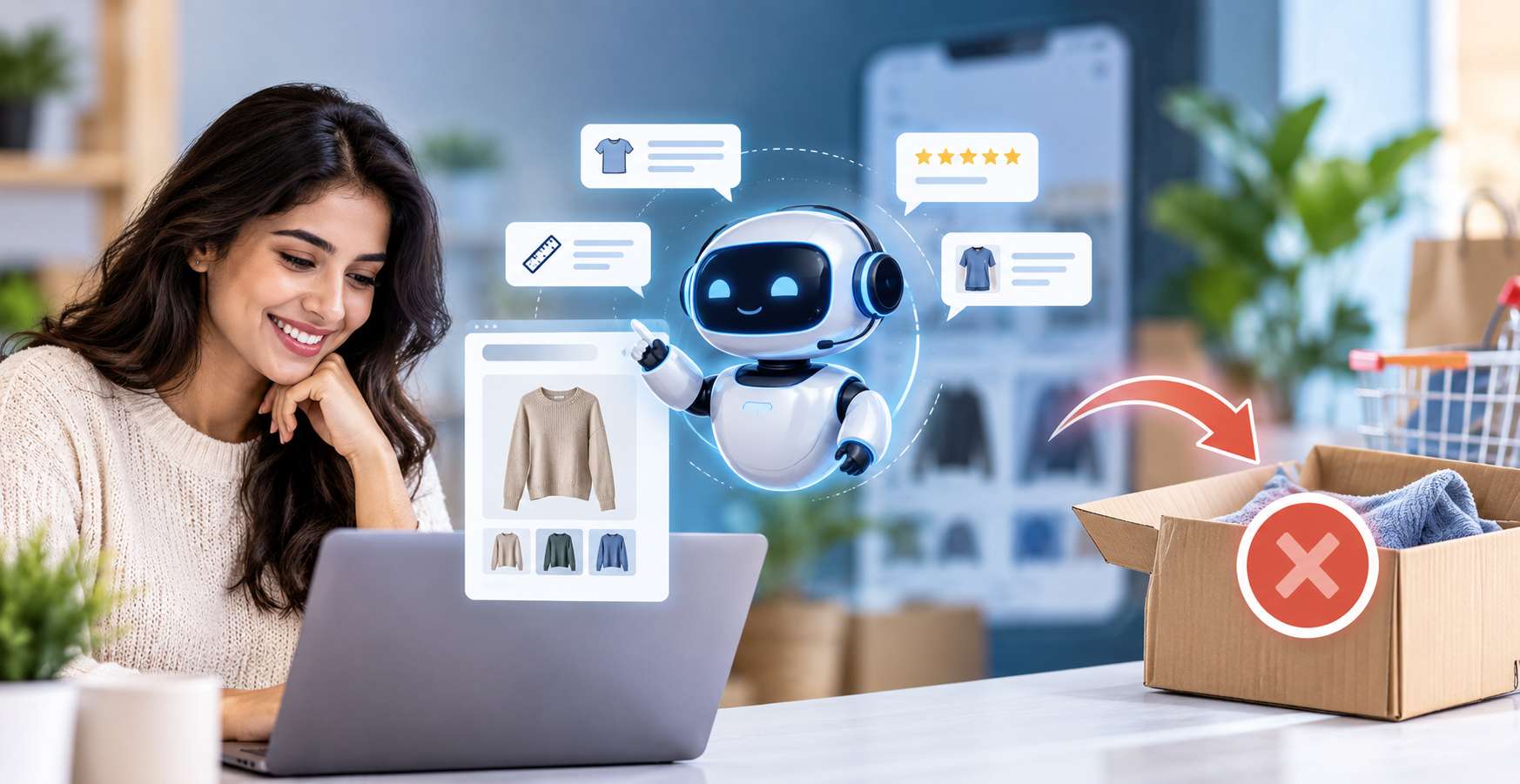
The average online return rate sits at 19 to 20.5% in 2026. That is more than double the 8.7 to 8.9% rate for brick-and-mortar stores. US shoppers returned an estimated 849.9 billion dollars in merchandise in 2025 alone.
For most ecommerce operators, the instinct is to treat returns as a fulfilment and refund problem. Something to manage after the box comes back.
That instinct is why so many return-reduction initiatives underperform. The decision that produces a return is usually made long before the package ships, often before checkout. An AI chatbot for ecommerce that intervenes at that earlier moment, when a shopper is uncertain about fit, colour, or whether a product will actually work for them, addresses the return at its source. Not its administrative aftermath.
This article covers what a return-cutting ecommerce chatbot does differently from a support widget. It covers the specific interventions that move the needle, and how to tell whether a deployment is genuinely reducing returns or just deflecting a few support tickets.
Why Return Reduction Is Fundamentally a Pre-Purchase Problem
The Real Return Reasons — Fit, Colour, Expectation Mismatch, Not Product Defect
Roughly half of returns trace back to a fit and expectation gap. That gap exists because shoppers can’t physically inspect a product before purchase (estimates across industry and academic sources range from about 45% to 70%. Separately, McKinsey research found that around 70% of fashion returns stem from preference-based reasons: poor fit, style mismatch, or an item that looks different than expected.
Product defects are a comparatively small share of the total. This distinction matters. A defect is a quality control problem. A fit and expectation mismatch is a pre-purchase information problem. The two need entirely different fixes.
Why the Decision to Return Is Often Made Before the Product Ships
An estimated 40% of consumers have engaged in bracketing, ordering multiple sizes or colours with the intent to return most of them. In these cases, the return isn’t a surprise or a product failure. It was planned at the moment of purchase, because the shopper didn’t have enough confidence to order a single correct item. The order itself already encodes the coming return.
Where Product Pages Alone Fall Short
A product detail page shows the same static information to every visitor. It doesn’t matter what their body type is, what they’ve bought before, or what specific questions they actually have. A shopper unsure whether a jacket runs large can’t ask the product page a follow-up question.
This gap, a page that can’t respond to an individual shopper’s real uncertainty, is exactly where a well-built AI chatbot for ecommerce operates.
What AI Chatbots for Ecommerce Actually Look Like in 2026
From Scripted Bots to Conversational Product Discovery
Chatbot adoption grew roughly 4.7 times between 2020 and 2025, a figure widely cited across industry roundups. The technology underneath that growth changed just as much. Early ecommerce bots matched keywords to canned responses. Modern conversational AI understands intent, asks clarifying questions, and holds context across a multi-turn conversation about a genuinely ambiguous purchase decision. It behaves closer to a knowledgeable store to associate than a search box with a chat interface.
From Text-Only to Multimodal (Voice, Image, Video Chat)
The strongest 2026 deployments aren’t text-only anymore. A shopper can upload a photo of their room to check whether the sofa’s colour will clash. Or describe a look verbally and have the assistant surface matching products.
This matters directly for returns. Colour and material misjudgment are one of the most common return triggers, and it’s much harder to make when the shopper can see or describe the product in their actual context before buying.
From Post-Purchase Support to Full Pre-Purchase Advisory
Most legacy chatbot deployments exist to answer “where is my order” questions after checkout. The 2026 shift is toward advisory chatbots active during product discovery and decision-making, before the purchase happens. This is the single biggest structural change separating a chatbot that reduces support ticket volume from one that reduces returns.
What Separates a Return-Cutting Chatbot From a Ticket-Deflection Chatbot
This is the distinction that determines whether any of the interventions below actually work. Before looking at the six specific tactics that reduce returns, it’s worth understanding what makes a chatbot capable of running them in the first place.
Deep Product Catalogue Integration and Attribute Modelling
A ticket-deflection chatbot answers generic policy questions from a knowledge base. A return-cutting chatbot needs structured access to real product attributes: fabric composition, true-to-size flags, weight, colour variance. That data has to come from the catalogue, not a marketing copy. Without this depth, the chatbot can’t answer the specific pre-purchase question that would have prevented the return. Product catalogue management can help ensure this product data is accurate and structured.
Access to Purchase History and Fit Preferences (First-Party Data)
A product discovery chatbot that remembers a returning shopper’s prior size purchases and fit feedback can give a genuinely personalized recommendation on the next purchase. It doesn’t need to start the sizing conversation from zero every time. This first-party data advantage is one of the clearest differences between a deployment built for return reduction and one built purely for generic support coverage.
Real-Time Inventory and Alternative-SKU Recommendation Logic
Sometimes a chatbot identifies that a shopper’s first-choice size or colour is likely to disappoint, based on fit history or known return patterns. When that happens, it needs real-time inventory visibility. Otherwise, it might suggest an in-stock alternative that turns out to be unavailable at checkout.
Session-Level Attribution — Knowing Which Conversations Prevented a Return
The most sophisticated deployments tag each chat session against the eventual order and its return outcome. That lets the business see, with actual data, which conversation types correlate with lower return rates. Without this session-level attribution, return reduction claims stay anecdotal instead of measured.
The Six Pre-Purchase Ecommerce Chatbot Interventions That Actually Reduce Returns
1. Guided Sizing Conversations With Body Data and Fit Preferences
Rather than a static size chart, a guided sizing conversation asks a shopper a handful of questions: prior brand and size, fit preference, body measurements if offered. It returns a specific size recommendation. Reported results vary by vendor and deployment, but AI-powered fit prediction tools have driven size-related return reductions in roughly the 20-35% range, with individual case studies reporting figures as high as 27-40% (Source; Alhena.ai, “Fit Analyzer vs Size Chart”). These are vendor-reported results rather than an independently audited average. They work because they replace a generic chart with a recommendation tailored to that individual shopper.
2. Visual Try-On and Room-Fit Previews Inside the Chat
Virtual try-on and room-fit preview features work best delivered inside the chat, not as a separate tool. A shopper can see how a garment sits on a body shape similar to theirs. Or how a piece of furniture looks in a room of the dimensions and lighting they describe. This directly addresses the expectation mismatch that drives most preference-based returns.
3. Realistic Product Expectation Setting (Colour, Weight, Feel, Material)
A good chatbot proactively surfaces material composition, actual weight, and colour variance under different lighting. It doesn’t wait to be asked. This prevents the single most common post-delivery disappointment: a product that technically matches its description but doesn’t match what the shopper pictured.
4. Cross-Sell Away From High-Return-Rate SKUs
Sometimes a shopper is browsing a product with a known high historical return rate for their profile. For example, a fit that consistently runs small for shoppers with a similar purchase history. A well-configured chatbot can proactively surface a comparable alternative with a stronger fit track record. That turns a likely return into a kept purchase.
5. Bracketing Detection at the Point of Checkout
An estimated 40% of consumers engage in bracketing at least some of the time, so catching it at checkout is high leverage. Catching it after the return request is much less useful. A chatbot that notices a shopper adding three sizes of the same item to cart can intervene directly. It can ask a fit question and help the shopper commit to one size with confidence, rather than ordering all three to sort out at home.
6. Post-Purchase, Pre-Delivery Interventions to Redirect a Likely Return
Even after checkout, there’s a window before delivery where a chatbot can proactively reach out. It can confirm size selection, offer an exchange before the item ships, or answer a lingering question the shopper never voiced. Most deployments underuse this late-stage window, despite it sitting squarely inside the pre-delivery period, when a redirect is still cheaper than a full return cycle.
Summary: The Six Interventions at a Glance
Category-by-Category Impact - Where Ecommerce Chatbots Cut Returns Most
Apparel and Footwear - Sizing and Fit
Average apparel return rates run 20 to 40%. Footwear specifically reaches as high as 31.4%, and women’s fashion sits at 27.8%. This is the category where guided sizing conversations and visual try-on deliver the clearest, most measurable impact. Sizing and fit account for the overwhelming majority of returns here.
Furniture and Home - Dimensions, Colour, Material
Furniture and home goods returns are driven heavily by dimension misjudgment and colour mismatch under real-room lighting. A chatbot with room-fit preview and material description functionality targets both failure points directly. Both are largely invisible on a standard product photo.
Consumer Electronics - Feature Fit and Compatibility
Electronics see comparatively lower return rates, around 10 to 12%. But the returns that do happen are often driven by compatibility confusion, will this work with my existing setup, rather than physical fit. A chatbot that can answer compatibility questions against a shopper’s stated existing devices addresses this category’s specific return driver directly.
Beauty and Personal Care - Shade Match and Skin Compatibility
Shade matching and skin type or sensitivity compatibility are the dominant return drivers in beauty. A chatbot that can guide shade selection using descriptive input or an uploaded photo, and flag known sensitivities against product ingredient lists, addresses the category’s core uncertainty before purchase. Not after a mismatched shade arrives.
How to Attribute Return Reduction to Chatbot Conversations
Chatbot-Engaged Session vs Non-Engaged Session Return Rates
The cleanest attribution comparison looks at the return rate of orders that included a chatbot conversation against orders that didn’t. Control for product category and price point. A meaningful, sustained gap between the two groups is the strongest evidence that the chatbot is genuinely influencing purchase decisions, not just handling post-purchase questions.
SKU-Level Return Rate Movement After Chatbot Rollout
Track the return rate for specific high-return SKUs before and after chatbot deployment, particularly SKUs the chatbot was configured to actively intervene on. This isolates the tool’s impact from broader seasonal or promotional return rate fluctuations. Those fluctuations would otherwise muddy a store-wide before-and-after comparison.
Post-Chat Conversion Rate and Basket Composition Change
AI chat users convert at roughly 12.3%, compared to 3.1% for non-chat sessions. That’s a 4x improvement. It’s worth tracking whether chat-assisted purchases also carry a different, more considered basket composition, fewer bracketed multi-size orders, for example. That connects the conversion lift directly to the return reduction goal, rather than treating them as two unrelated wins.
Cost Per Prevented Return
Processing a single return costs an estimated 20 to 66% of the item’s original price, once shipping, inspection, restocking, and markdown are factored in. Model the cost per prevented return: chatbot platform and operational cost, divided by the estimated number of returns avoided. That gives a defensible ROI figure that a generic chatbot satisfaction score can’t provide.
Failure Modes When Ecommerce Chatbots Underperform on Returns
Deployed as a Support Widget Instead of a Product Discovery Tool
The most common failure is technical success paired with strategic misplacement. A chatbot that works well but only appears after checkout, or deep in a support flow, can no longer influence the purchase decision that produces most returns. AI in ecommerce customer service can help brands engage shoppers earlier in the purchase journey.
No Access to Real Product Attributes Beyond Marketing Copy
A chatbot restricted to the same marketing copy already on the product page adds a conversational interface without adding new information. It can’t answer the specific fit or material question that would have changed the shopper’s decision, because it has nothing more to say than the page already said.
Guardrails Missing on Product Claim Language (Compliance Risk)
An ungoverned chatbot can generate confident-sounding claims about a product that aren’t accurate. An overstated durability claim, or an incorrect compatibility assurance. For example, if a product listing describes a jacket as “water-resistant” without specifying a rating, an ungoverned chatbot might tell a shopper it’s fine to wear in heavy rain, creating a claim the product can’t back up and a near-certain return when it fails to perform as promised. This kind of gap creates both a return and a potential compliance or consumer protection exposure. Guardrails on claim language are a requirement, not an optional refinement.
No Feedback Loop From Chat Transcripts to Merchandising Team
Chat transcripts contain a direct, unfiltered record of exactly what shoppers are confused about before they buy. Deployments that never route this signal back to merchandising and product teams waste the richest source of return-cause data the business has. The underlying product page or listing problem stays unaddressed indefinitely.
What to Evaluate Before Rolling Out an AI Chatbot on an Ecommerce Site
Product Data Readiness and Attribute Depth
Before evaluating any chatbot vendor, audit the underlying product catalogue. Does it actually contain the attribute depth, true fit notes, material composition, accurate weight, a chatbot would need to answer real pre-purchase questions? A sophisticated chatbot layered on thin product data will underperform regardless of the AI model behind it.
Platform Integration (Shopify, Salesforce Commerce Cloud, Adobe Commerce)
Confirm genuine, tested integration with the specific ecommerce platform in use: Shopify, Salesforce Commerce Cloud, Adobe Commerce, or a custom stack. That includes real-time inventory and order history access, not just a generic compatibility claim that hasn’t been validated against the actual environment.
Post-Deployment Ownership Between CX, Merchandising, and Data Teams
A return-cutting chatbot sits at the intersection of customer experience, merchandising, and data functions. Without clear ownership across these teams for reviewing performance and acting on the insight it surfaces, the tool degrades into a support widget by default. That happens regardless of its original design intent.
How the Chatbot Coordinates With Your Existing Returns Data Programme
The chatbot shouldn’t operate in isolation from whatever returns tracking and analytics the business already runs. Shared data between the two systems is what makes session-level attribution and SKU-level return tracking possible in the first place.
How a CX Operations Partner Supports an AI Chatbot for Ecommerce
Standing up a genuinely return-cutting chatbot requires more than licensing a platform. It takes product data audit and enrichment, integration work across the ecommerce platform and inventory systems, ongoing tuning of the conversation flows that actually move return rates, and a feedback loop back to merchandising. Most internal teams don’t have the bandwidth to run all of that continuously. A CX operations partner with ecommerce-specific experience brings that operational layer: the audit, the integration, the ongoing measurement discipline. That’s what separates a chatbot pilot from a chatbot that demonstrably reduces returns quarter over quarter.
Conclusion
The ecommerce brands cutting return rates in 2026 share one trait: they stopped treating returns as a fulfilment problem and started treating them as a product-discovery problem. The decision to return is usually made before checkout, and that is where the intervention has to happen too. Returns can cost up to 66% of an item’s value to process, and the average online return rate sits near 20%, so the financial case for getting this positioning right is not subtle.
1Point1 works with retailers on exactly that shift. We integrate with Shopify, Salesforce Commerce Cloud, and Adobe Commerce. Every deployment starts with a product data audit: checking whether the catalogue actually has the attribute depth, true fit notes, material composition, accurate weight, a chatbot needs to answer real pre-purchase questions, before we touch conversation design. Fit-prediction tools built on that foundation have driven size-related return reductions in the 20-35% range in vendor case studies. Getting a comparable result on your own catalogue starts with confirming the underlying product data can support it.
Visit https://www.1point1.com/ to talk to our team about what that audit would find on your store.